Waste Knots and All

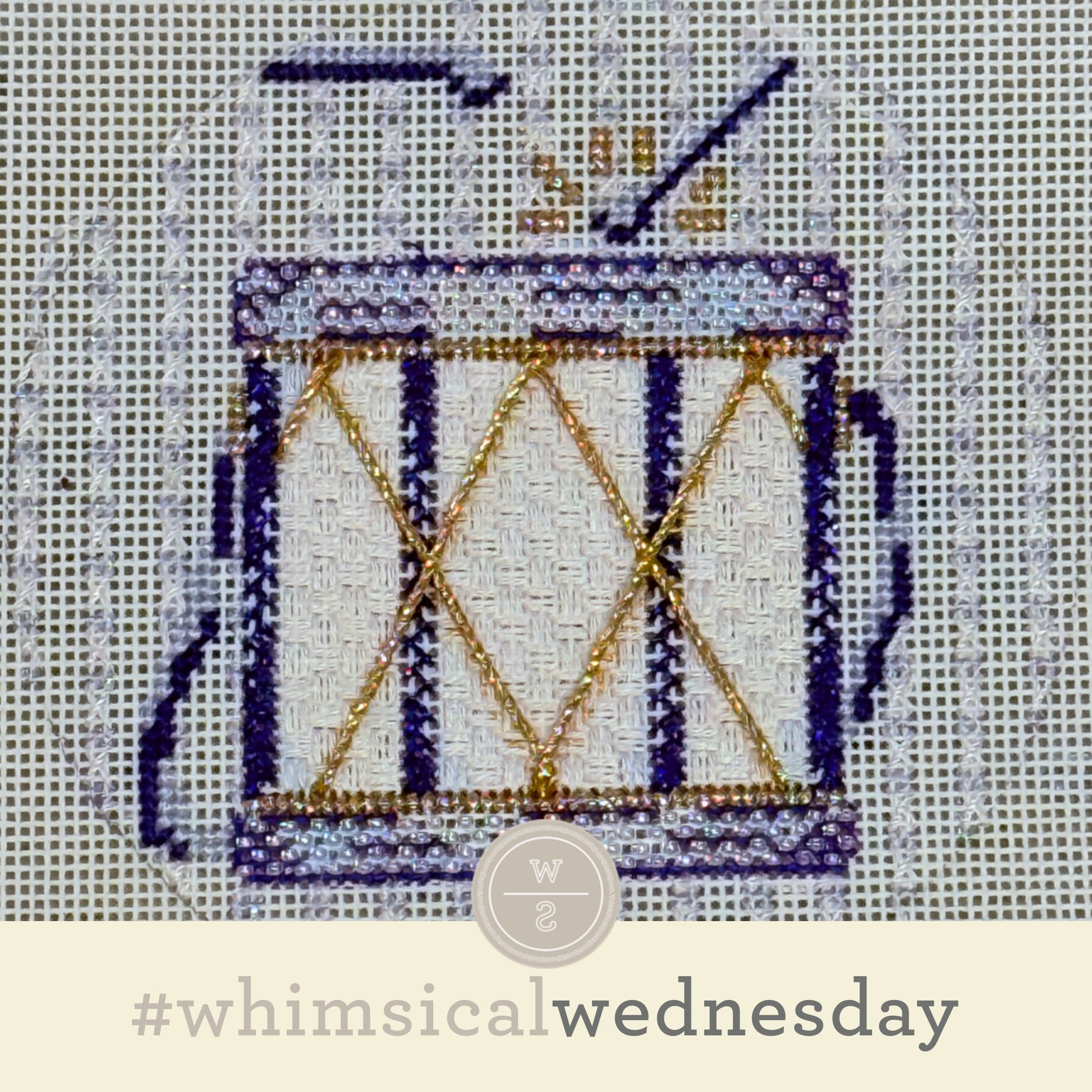
Today’s stitch was inspired by a fun stitch from Bedecked and Beadazzled I shared a few years ago. It’s also a work in progress, but a great opportunity to see how I work to minimize visible threads.

Click on image to see on pinterest. Visit pinterest.com/whimsicalstitch/whimsicalwednesday for a library of all #whimsicalwednesday and #smallspacesunday stitch diagrams.
Click the image to see #whimsicalwednesday and #smallspacesunday Stitched Sample Gallery on Instagram

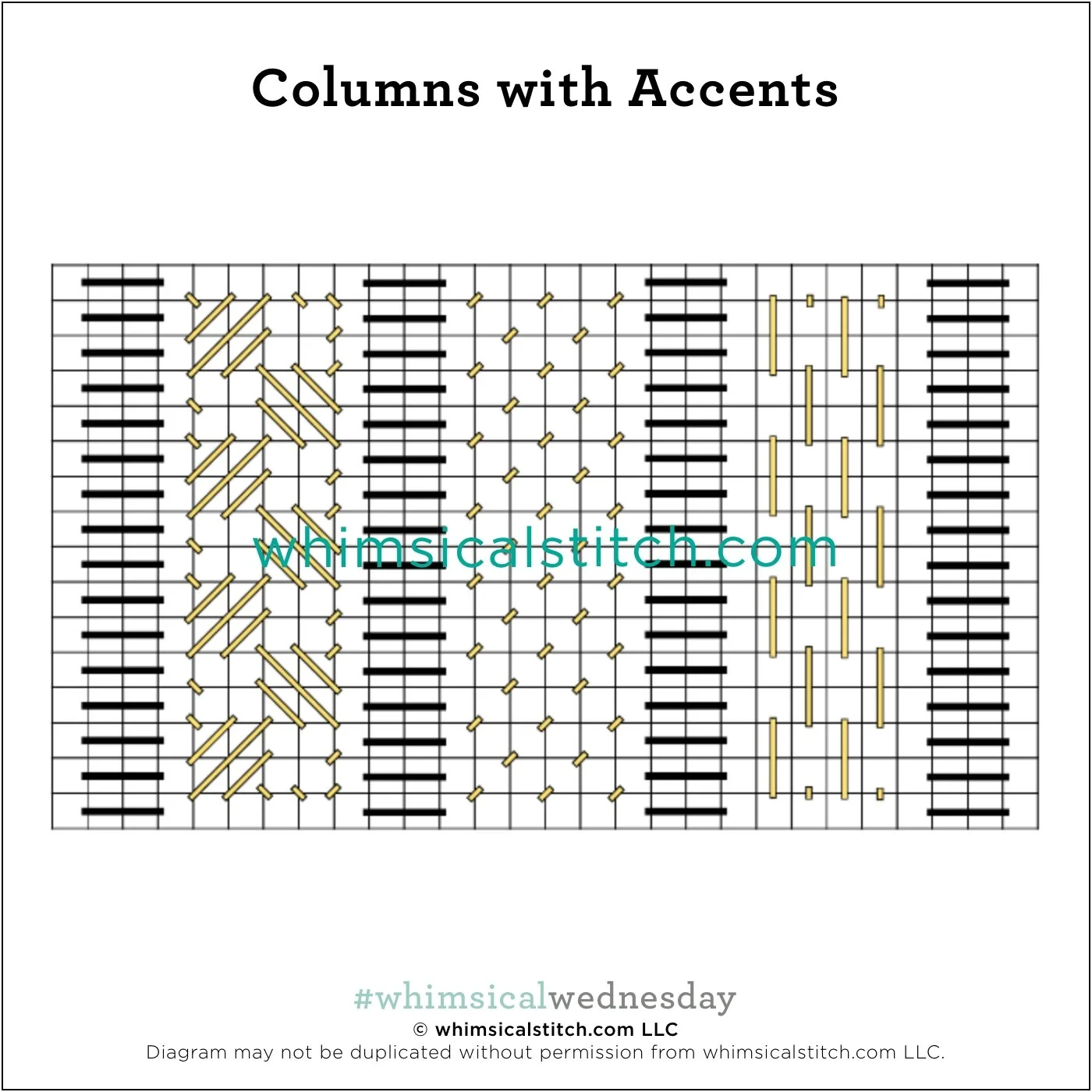
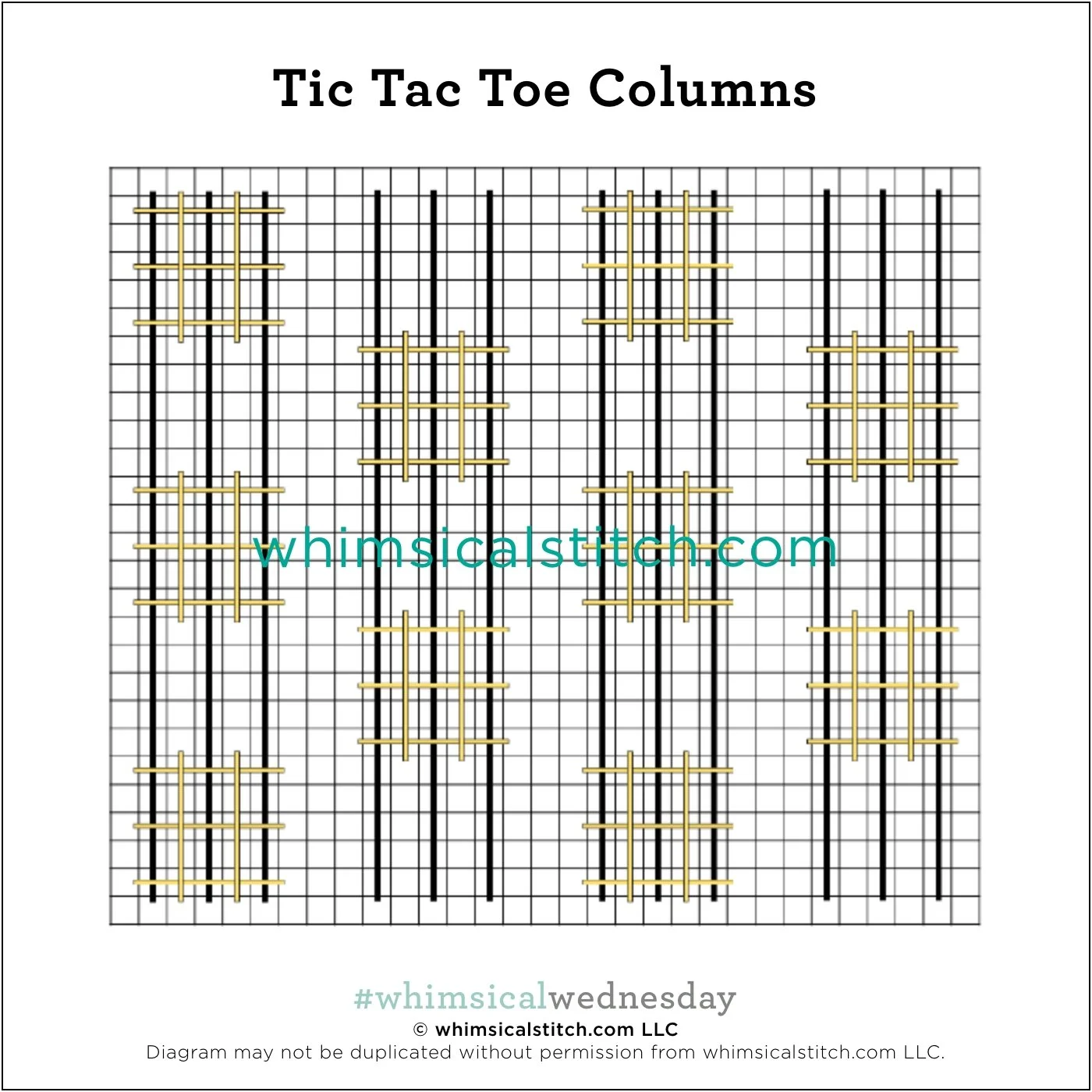
First, the stitch. I used blue Pepper Pot Silk (black lines) and size 12 Kreinik braid (yellow lines). The original plan was to stitch just the horizontal yellow lines, similar to the inspiration stitch. But something was missing, so I added the vertical lines on top of the horizontal lines and was happy with where I landed. Well, honestly, I may change the Kreinik to a lighter-weight metallic to make it recede a little bit.

I like this as a background stitch and you can add more or less space between the columns to achieve the coverage you want. I’m looking forward to using this on a basket with an overdyed wool for the black lines with a solid color silk floss for the yellow lines and NO skipped rows between the columns.

There are two examples of how I navigate open stitches on the stitched sample. The first, a small running stitch, is in the lower right-hand corner. When I completed the column on the far right, I needed to return to start the column under the S. The running stitch 1-2 rows away from the design area will be swallowed by the fabrication of the ornament. Magic! There is a waste knot (aka away knot) underneath the long vertical stitches on the upper right of the canvas. I added that knot in the direct path of the long vertical stitch and it will stay there until I add the Kreinik on top of those three stitches.

Today’s stitch diagram, along with all other #whimsicalwednesday and #smallspacesunday stitch diagrams, can also be found on a Pinterest board here. Be sure to follow whimsicalstitch.com on FacebookPinterest, and Instagram.

Click on image to see the whimsicalstitch.com Stitch Library on pinterest.com. Includes all #whimsicalwednesday and #smallspacesunday stitch diagrams.

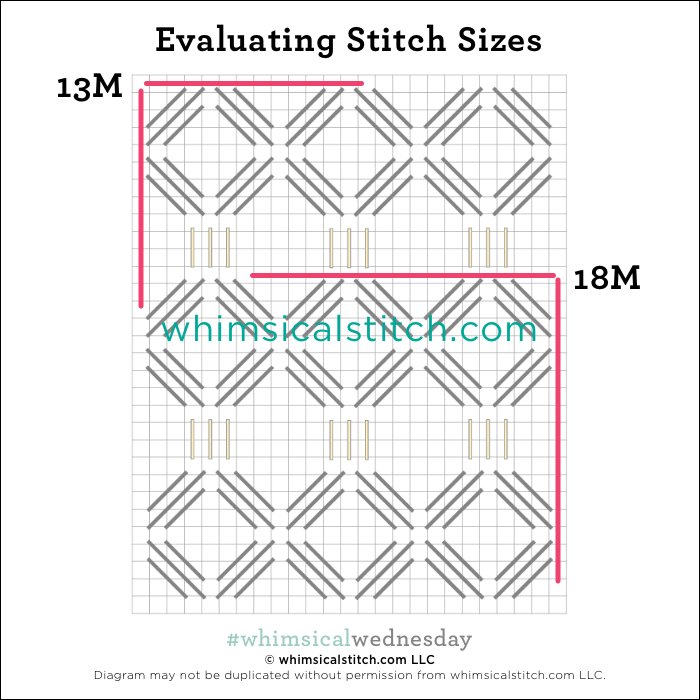
As you are auditioning stitches (from any stitch source), count the number of canvas threads on the diagram that match your mesh size. And there you have what an inch of the stitch will look like. Evaluate that against the area where you plan to use the stitch and make your final decision. If you start integrating this step into your stitch selection process, you may be surprised at how many stitches you think are large are much smaller than you realize.

More from whimsicalstitch.com
If you like what you see on this blog, there's more. Mary’s Whimsical Stitches is a series of four books offering contemporary how-to collections of more than 200 stitches (in each volume) for all stitchers, regardless of skill level. All books include updated and sequenced diagrams from this blog, plus a collection of all-new stitches from private lessons and other class projects. Visit here to find a needlepoint retailer that carries my books.

New to needlepoint or looking for a refresher? Please download a handy how-to guide covering basic needlepoint stitches and stitch compensation techniques, along with new top-line information on needlepoint materials and tools, how to handle threads, and other helpful needlepoint resources.

A Note about Diagrams
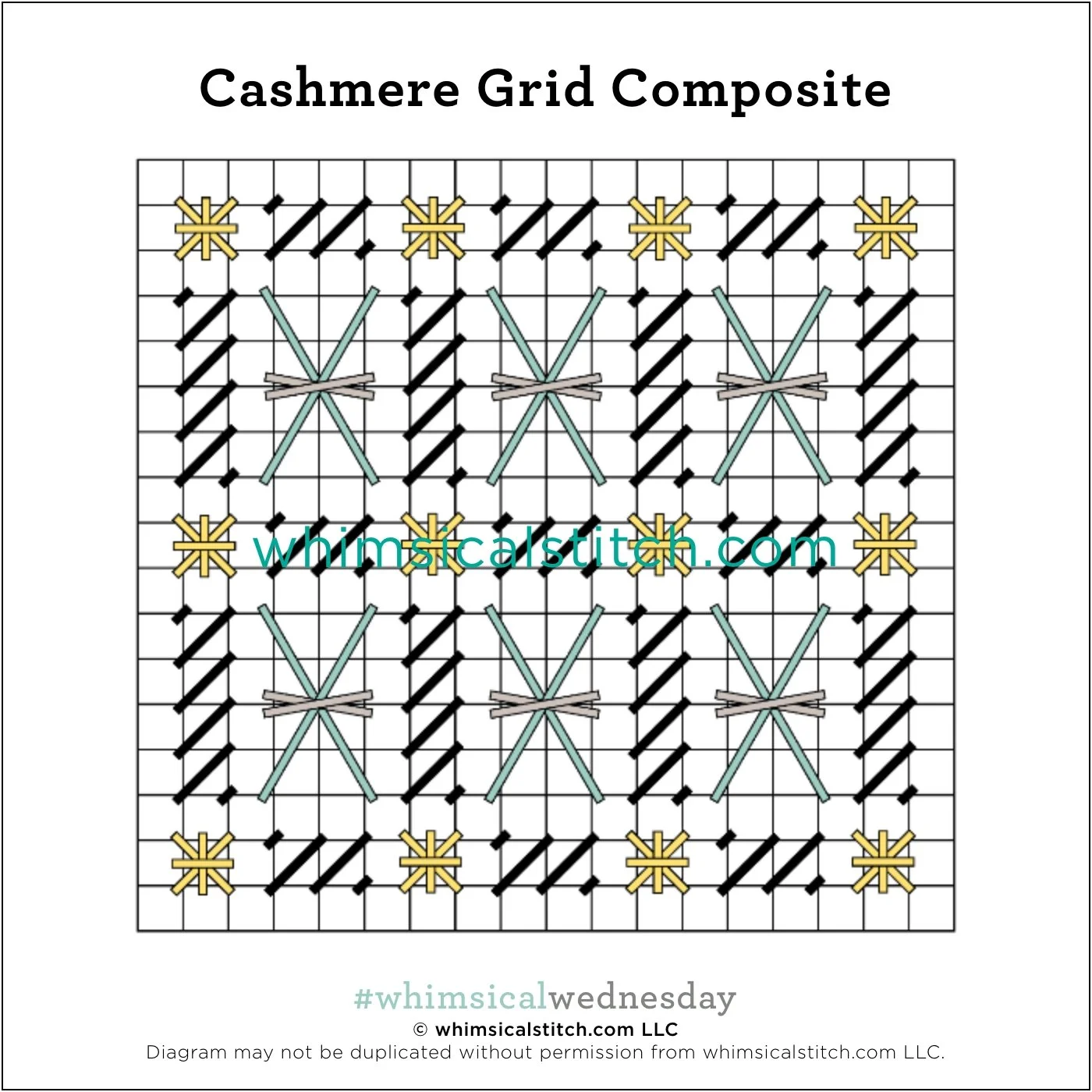
I use color in diagrams to make them as clear as possible.  The primary function of different colored lines is to illustrate a stitch sequence.  For example, the layering of colors demonstrates you add them in that order.  They can also provide ideas on integrating additional threads (one line for each color).  Or, you can use the same thread for all color lines.  That's where I encourage you to use your imagination for the space you are stitching!
This is Not Last Week

Today’s stitch is a fun little experiment for a background and, unlike last week, super easy.  

Click on image to see on pinterest. Visit pinterest.com/whimsicalstitch/whimsicalwednesday for a library of all #whimsicalwednesday and #smallspacesunday stitch diagrams.

Click the image to see #whimsicalwednesday and #smallspacesunday Stitched Sample Gallery on Instagram

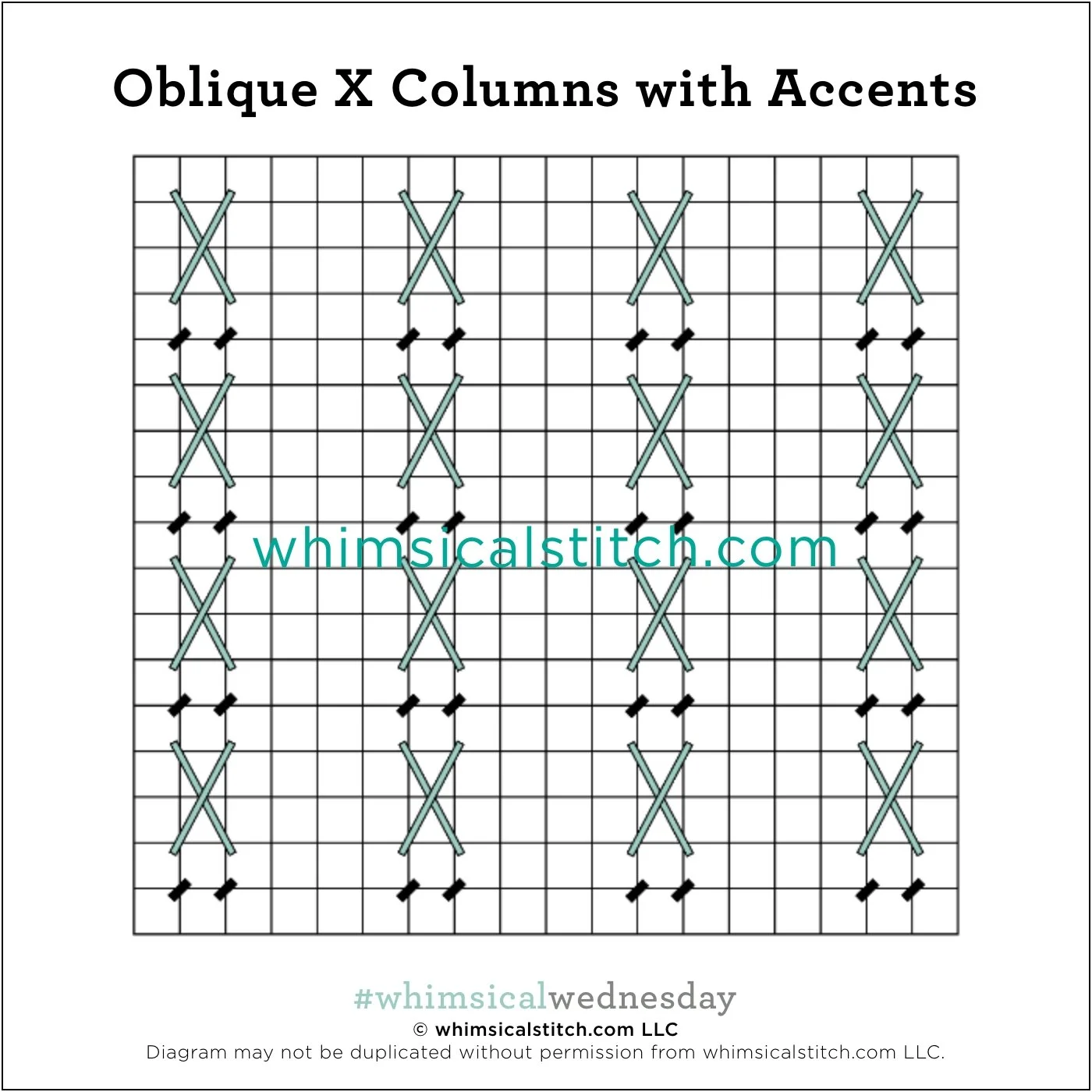
The stitched sample is a background for the Twelve Drummers Drumming of the Plum Stitchery Twelvetide set. I used white Elegance for the aqua lines and a light blue Petite Silk Lame for the black lines. I like the simplicity of the stitch, combined with the little pop of color with the blue accents.

It would be so easy and cute to replace the tent stitches with seed beads, or even a bugle bead. I want to play with this a little to create a grid of sorts, so I have that fun to look forward to. Naturally, you can make the oblique crosses taller for larger areas. There’s a lot to come from this stitch. I hope you have the perfect spot for it.

Today’s stitch diagram, along with all other #whimsicalwednesday and #smallspacesunday stitch diagrams, can also be found on a Pinterest board here. Be sure to follow whimsicalstitch.com on FacebookPinterest, and Instagram.

Today’s stitch diagram, along with all other #whimsicalwednesday and #smallspacesunday stitch diagrams, can also be found on a Pinterest board here. Be sure to follow whimsicalstitch.com on FacebookPinterest, and Instagram.

Click on image to see the whimsicalstitch.com Stitch Library on pinterest.com. Includes all #whimsicalwednesday and #smallspacesunday stitch diagrams.

As you are auditioning stitches (from any stitch source), count the number of canvas threads on the diagram that match your mesh size. And there you have what an inch of the stitch will look like. Evaluate that against the area where you plan to use the stitch and make your final decision. If you start integrating this step into your stitch selection process, you may be surprised at how many stitches you think are large are much smaller than you realize.

More from whimsicalstitch.com
If you like what you see on this blog, there's more. Mary’s Whimsical Stitches is a series of four books offering contemporary how-to collections of more than 200 stitches (in each volume) for all stitchers, regardless of skill level. All books include updated and sequenced diagrams from this blog, plus a collection of all-new stitches from private lessons and other class projects. Visit here to find a needlepoint retailer that carries my books.

New to needlepoint or looking for a refresher? Please download a handy how-to guide covering basic needlepoint stitches and stitch compensation techniques, along with new top-line information on needlepoint materials and tools, how to handle threads, and other helpful needlepoint resources.

A Note about Diagrams
I use color in diagrams to make them as clear as possible.  The primary function of different colored lines is to illustrate a stitch sequence.  For example, the layering of colors demonstrates you add them in that order.  They can also provide ideas on integrating additional threads (one line for each color).  Or, you can use the same thread for all color lines.  That's where I encourage you to use your imagination for the space you are stitching!

Please Learn From My Mistake

Today’s stitch is gorgeous (IMO). Today’s stitch is a challenge to stitch. Please don’t stitch it in the sequence I did. Meaning, please keep reading.

Click on image to see on pinterest. Visit pinterest.com/whimsicalstitch/whimsicalwednesday for a library of all #whimsicalwednesday and #smallspacesunday stitch diagrams.

Click the image to see #whimsicalwednesday and #smallspacesunday Stitched Sample Gallery on Instagram

A lovely alternative stitch if you don’t want to pull your hair out like I did.

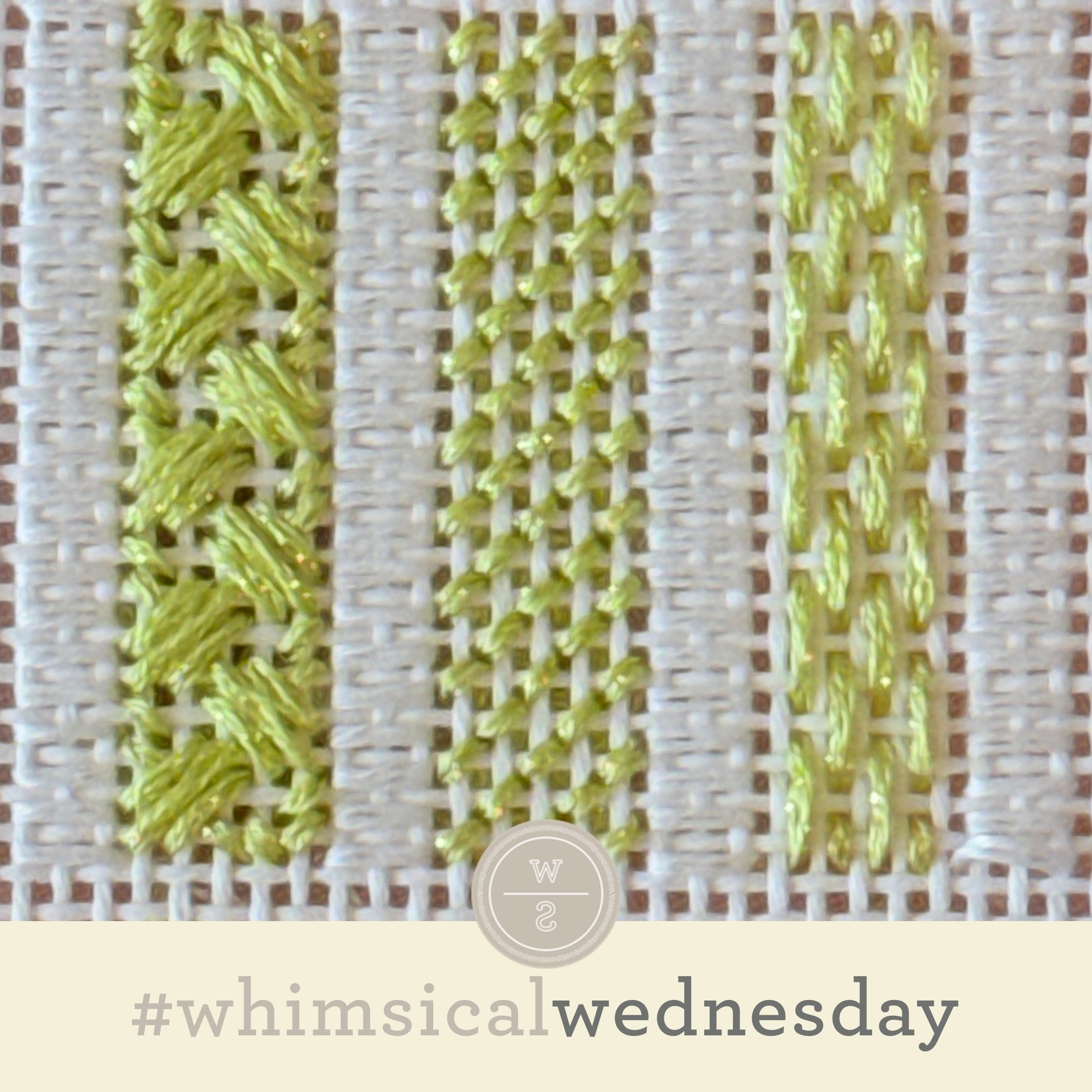
A stitching friend sent me today’s stitch. It was love at first sight for me. I seem to be on a background stitch of late, so I thought this would be a great addition. The stitched sample uses two plies of white Mandarin Floss (black lines) and green Kreinik Very Fine Braid (size 4) on 18M. I absolutely love everything about this stitch…except stitching it for the first time. Last night. After I got back from a long weekend in wine country.

Created the diagram and did what I always do…I stitched the primary threads (black lines) first. Gah! What a mistake. Stared at the stitching, stared at the diagram, and realized I should have stitched the easiest to follow pattern first. Ripped it all out and added the yellow lines first. What a difference. Took me about half the time as the first pass.

The second pass also revealed a lovely alternative (photo on far right). It’s only the yellow lines, and it’s way more open, but there is always a place where an understated open stitch will work. I hope you have the perfect spot for either of these background stitches. More importantly, I hope you have an easier time with your first pass than I did. I am glad I persevered because I really do love both versions.

Today’s stitch diagram, along with all other #whimsicalwednesday and #smallspacesunday stitch diagrams, can also be found on a Pinterest board here. Be sure to follow whimsicalstitch.com on FacebookPinterest, and Instagram.

Click on image to see the whimsicalstitch.com Stitch Library on pinterest.com. Includes all #whimsicalwednesday and #smallspacesunday stitch diagrams.

As you are auditioning stitches (from any stitch source), count the number of canvas threads on the diagram that match your mesh size. And there you have what an inch of the stitch will look like. Evaluate that against the area where you plan to use the stitch and make your final decision. If you start integrating this step into your stitch selection process, you may be surprised at how many stitches you think are large are much smaller than you realize.

More from whimsicalstitch.com
If you like what you see on this blog, there's more. Mary’s Whimsical Stitches is a series of four books offering contemporary how-to collections of more than 200 stitches (in each volume) for all stitchers, regardless of skill level. All books include updated and sequenced diagrams from this blog, plus a collection of all-new stitches from private lessons and other class projects. Visit here to find a needlepoint retailer that carries my books.

New to needlepoint or looking for a refresher? Please download a handy how-to guide covering basic needlepoint stitches and stitch compensation techniques, along with new top-line information on needlepoint materials and tools, how to handle threads, and other helpful needlepoint resources.

A Note about Diagrams
I use color in diagrams to make them as clear as possible.  The primary function of different colored lines is to illustrate a stitch sequence.  For example, the layering of colors demonstrates you add them in that order.  They can also provide ideas on integrating additional threads (one line for each color).  Or, you can use the same thread for all color lines.  That's where I encourage you to use your imagination for the space you are stitching!
Be a Star

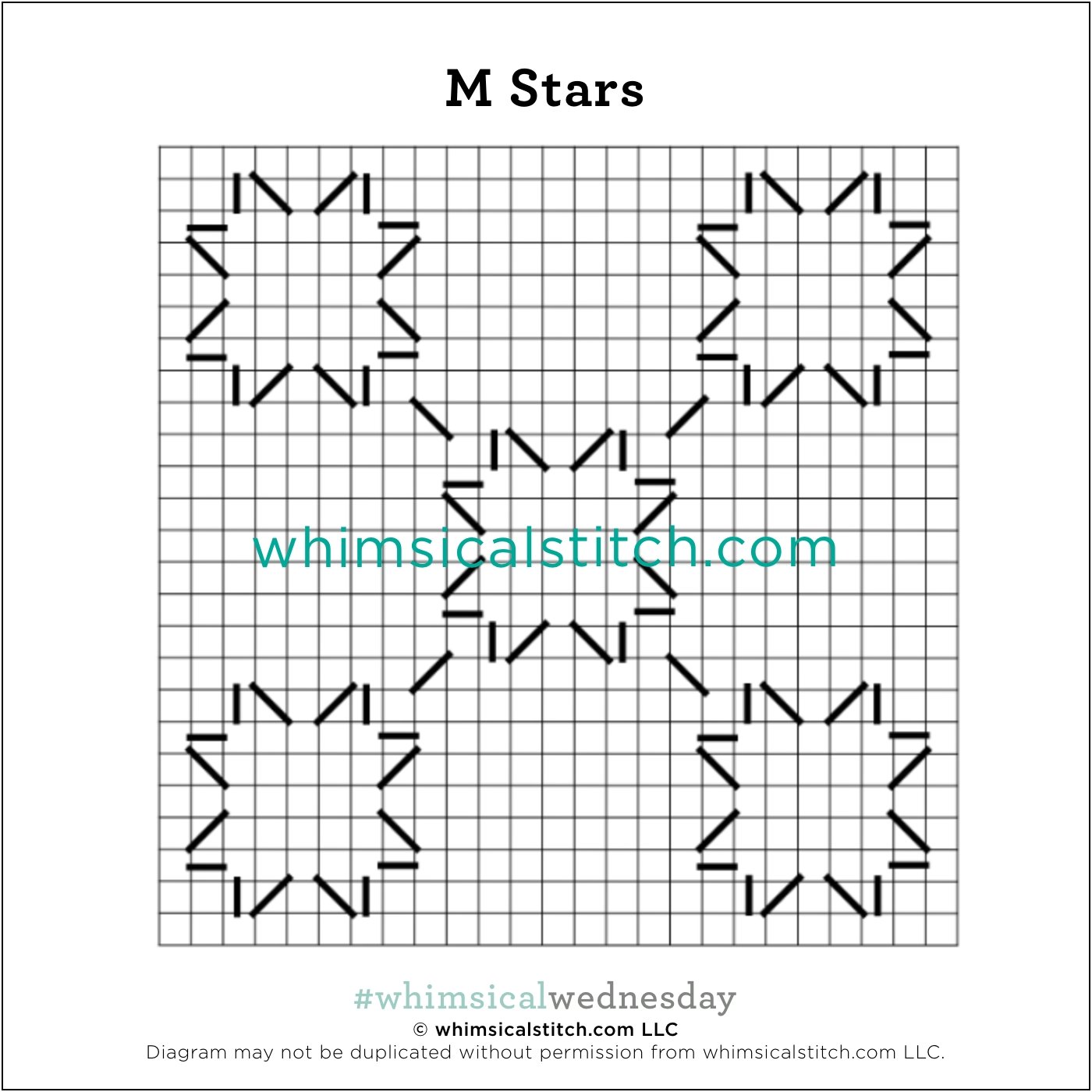
Today’s stitch is a happy stitch with a gentle reminder (from one of my favorite stitchers) to always be a star.

Click on image to see on pinterest. Visit pinterest.com/whimsicalstitch/whimsicalwednesday for a library of all #whimsicalwednesday and #smallspacesunday stitch diagrams.

Click the image to see #whimsicalwednesday and #smallspacesunday Stitched Sample Gallery on Instagram

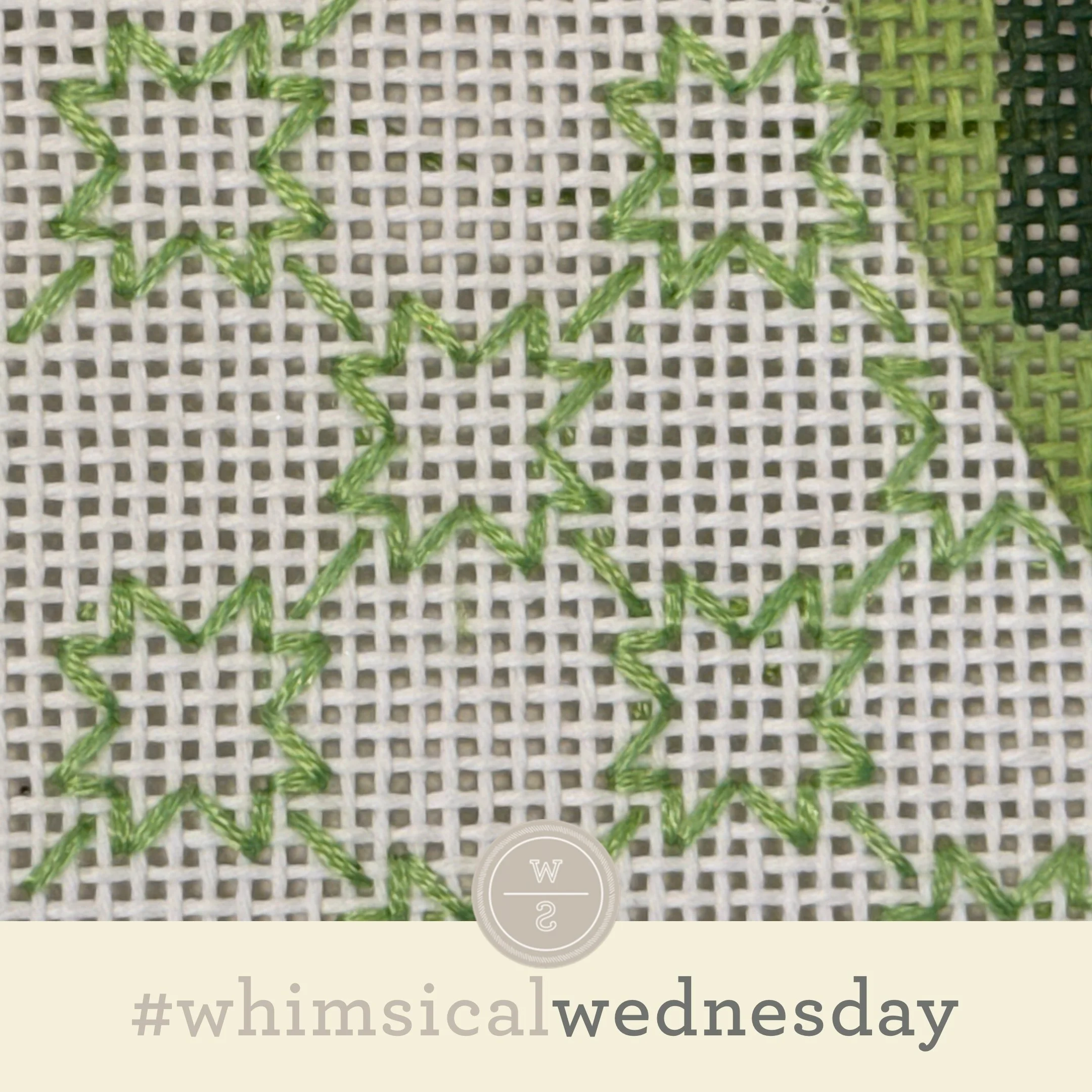
The stitch draws inspiration from an embroidery stitch I found on Instagram. I love the initial shape…basically four M’s creating a fun star (or snowflake). The stitched sample is me working with three plies of Soie D'Alger on 13M. This stitch is made for a background or a sky. Imagine a light blue or gray winter sky with a matching metallic for a snowy sky. Perfection.

You can also add individual stars randomly. (I also understand the majority of the needlepoint community may have just groaned at that.) I also experimented with stitching the stars immediately adjacent to each other and wasn’t thrilled with the end result. I do want to play with creating columns of snowflakes. Because, columns. Duh.

Today’s stitch diagram, along with all other #whimsicalwednesday and #smallspacesunday stitch diagrams, can also be found on a Pinterest board here. Be sure to follow whimsicalstitch.com on FacebookPinterest, and Instagram.

I hope you have the perfect spot for this stitch! Please enjoy! Have a wonderful #whimsicalwednesday!

Click on image to see the whimsicalstitch.com Stitch Library on pinterest.com. Includes all #whimsicalwednesday and #smallspacesunday stitch diagrams.

As you are auditioning stitches (from any stitch source), count the number of canvas threads on the diagram that match your mesh size. And there you have what an inch of the stitch will look like. Evaluate that against the area where you plan to use the stitch and make your final decision. If you start integrating this step into your stitch selection process, you may be surprised at how many stitches you think are large are much smaller than you realize.

More from whimsicalstitch.com
If you like what you see on this blog, there's more. Mary’s Whimsical Stitches is a series of four books offering contemporary how-to collections of more than 200 stitches (in each volume) for all stitchers, regardless of skill level. All books include updated and sequenced diagrams from this blog, plus a collection of all-new stitches from private lessons and other class projects. Visit here to find a needlepoint retailer that carries my books.

New to needlepoint or looking for a refresher? Please download a handy how-to guide covering basic needlepoint stitches and stitch compensation techniques, along with new top-line information on needlepoint materials and tools, how to handle threads, and other helpful needlepoint resources.


A Note about Diagrams
I use color in diagrams to make them as clear as possible.  The primary function of different colored lines is to illustrate a stitch sequence.  For example, the layering of colors demonstrates you add them in that order.  They can also provide ideas on integrating additional threads (one line for each color).  Or, you can use the same thread for all color lines.  That's where I encourage you to use your imagination for the space you are stitching!
My Third Needlepoint Love

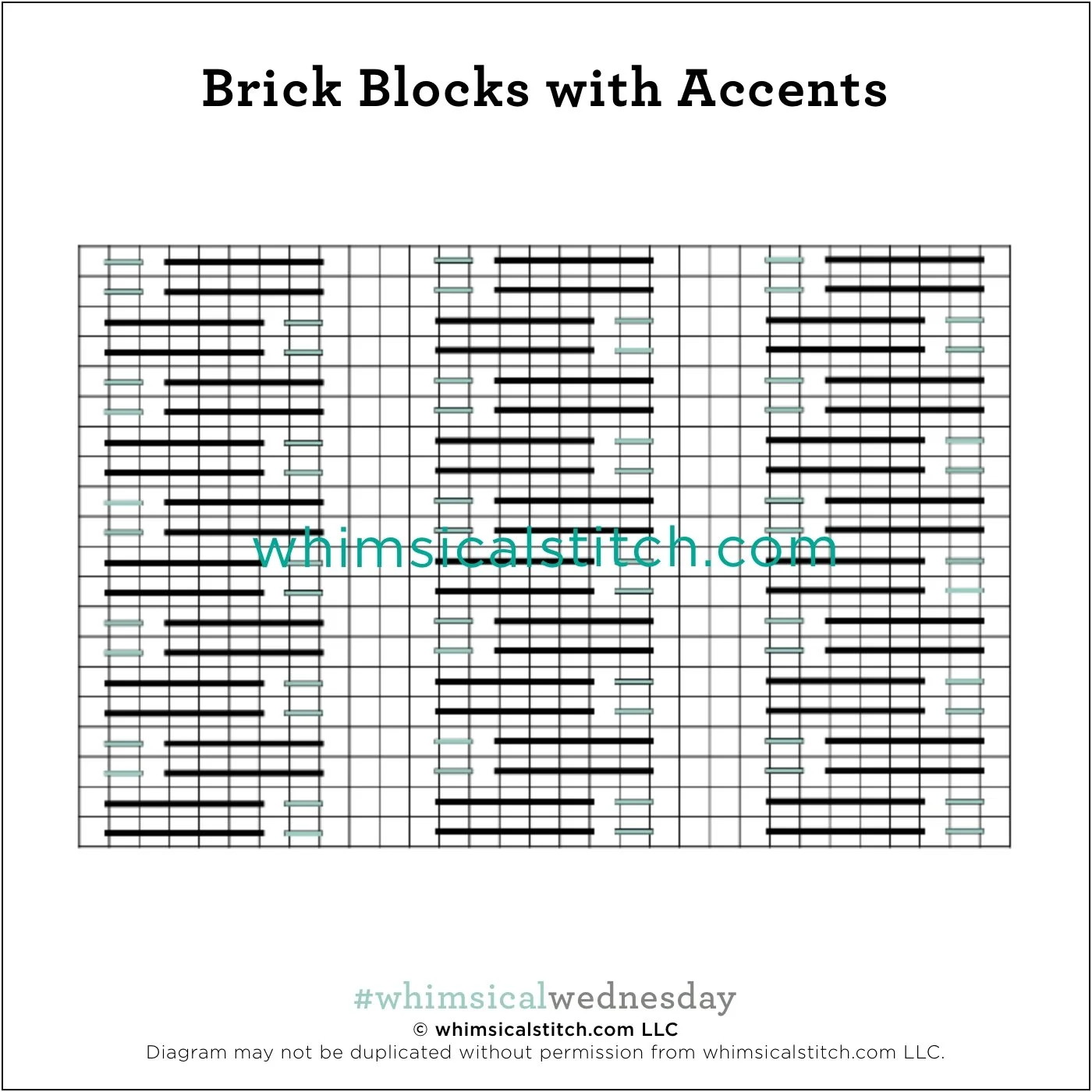
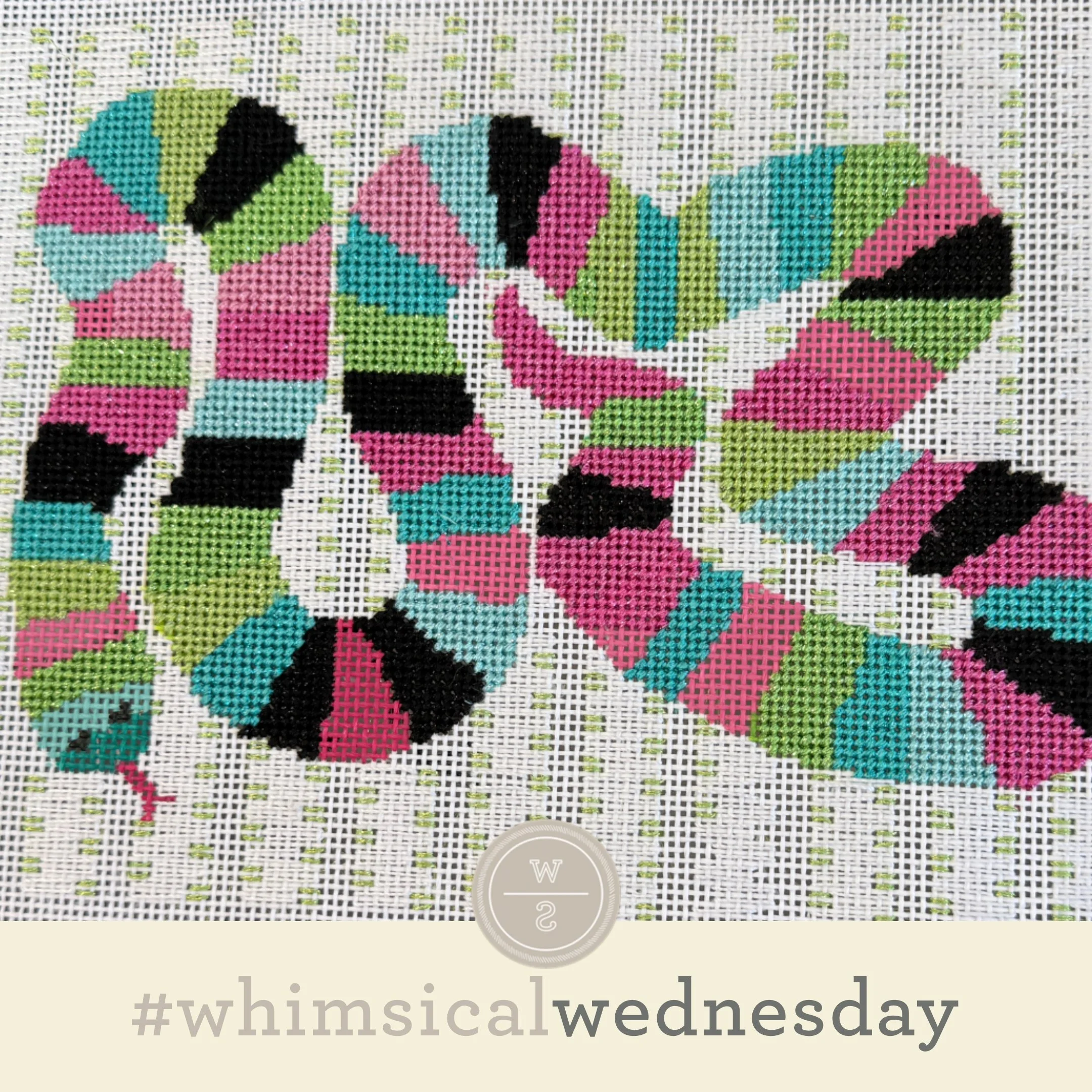
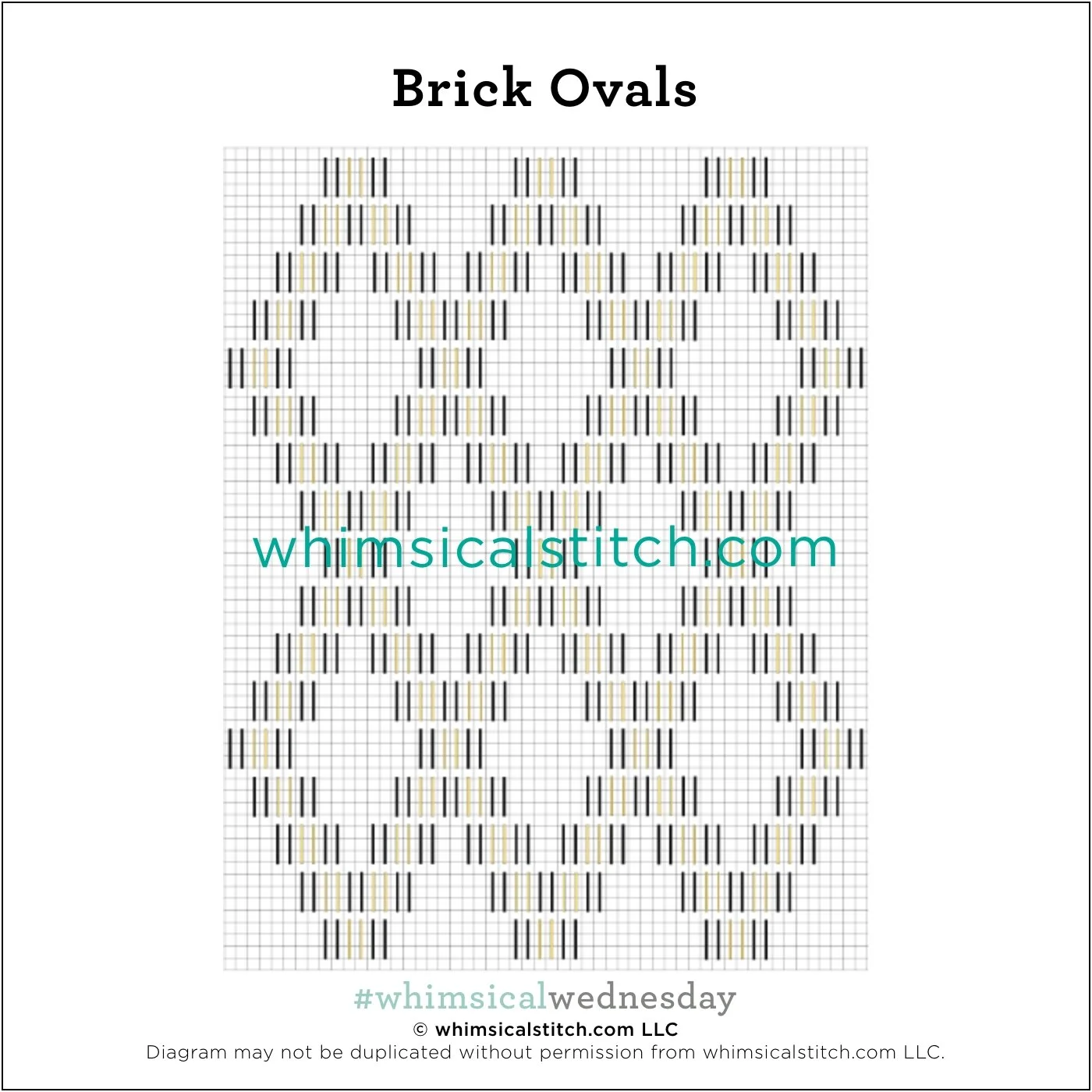
My view is that virtually any stitch can be transformed into columns, especially for backgrounds. Today’s stitch takes brick blocks and, voila!, we have a simple and fun background to accompany an adorable snake. (Adorable snake. Not a phrase I ever expected to write in my lifetime.)

Click on image to see on pinterest. Visit pinterest.com/whimsicalstitch/whimsicalwednesday for a library of all #whimsicalwednesday and #smallspacesunday stitch diagrams.

Click the image to see #whimsicalwednesday and #smallspacesunday Stitched Sample Gallery on Instagram

The snake is a darling pillow that a customer is making for her grandson. And I love the colors. She picked her favorite color from the snake for the accent stitch. The black lines use size 8 DMC perle cotton and the aqua lines are green Radiance 18. If you have more white space, I encourage you to add more space between the columns for an even cleaner look. For example, you could use two shades of a thread for a background on a still life or even a monogram.

Today’s stitch diagram, along with all other #whimsicalwednesday and #smallspacesunday stitch diagrams, can also be found on a Pinterest board here. Be sure to follow whimsicalstitch.com on FacebookPinterest, and Instagram.

I hope you have the perfect spot for this stitch! Please enjoy! Have a wonderful #whimsicalwednesday!

Click on image to see the whimsicalstitch.com Stitch Library on pinterest.com. Includes all #whimsicalwednesday and #smallspacesunday stitch diagrams.

As you are auditioning stitches (from any stitch source), count the number of canvas threads on the diagram that match your mesh size. And there you have what an inch of the stitch will look like. Evaluate that against the area where you plan to use the stitch and make your final decision. If you start integrating this step into your stitch selection process, you may be surprised at how many stitches you think are large are much smaller than you realize.

More from whimsicalstitch.com
If you like what you see on this blog, there's more. Mary’s Whimsical Stitches is a series of four books offering contemporary how-to collections of more than 200 stitches (in each volume) for all stitchers, regardless of skill level. All books include updated and sequenced diagrams from this blog, plus a collection of all-new stitches from private lessons and other class projects. Visit here to find a needlepoint retailer that carries my books.

New to needlepoint or looking for a refresher? Please download a handy how-to guide covering basic needlepoint stitches and stitch compensation techniques, along with new top-line information on needlepoint materials and tools, how to handle threads, and other helpful needlepoint resources.


A Note about Diagrams
I use color in diagrams to make them as clear as possible.  The primary function of different colored lines is to illustrate a stitch sequence.  For example, the layering of colors demonstrates you add them in that order.  They can also provide ideas on integrating additional threads (one line for each color).  Or, you can use the same thread for all color lines.  That's where I encourage you to use your imagination for the space you are stitching!
My Second Needlepoint Love

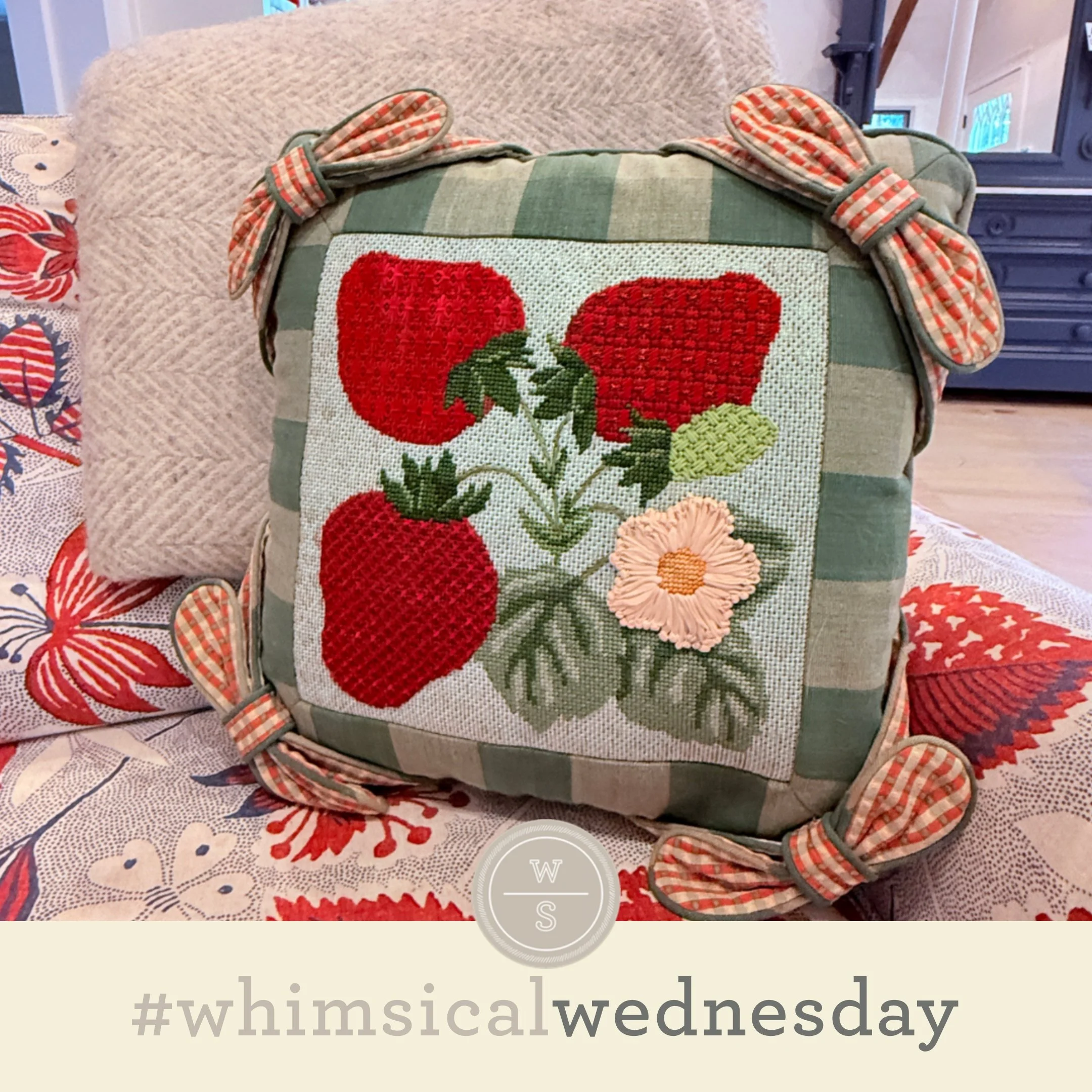
After more than a few years of stitching Christmas decor, I walked into Aristeia (in Brentwood, CA at the time) and saw a huge red apple on the wall. It was love at first sight and I went down the fruit pillow path for yeeeeeeaars. A common quote upon entering my house is, “Oh, there are all the fruit pillows!” Today’s stitch comes from one of those pillows.

Click on image to see on pinterest. Visit pinterest.com/whimsicalstitch/whimsicalwednesday for a library of all #whimsicalwednesday and #smallspacesunday stitch diagrams.

Click the image to see #whimsicalwednesday and #smallspacesunday Stitched Sample Gallery on Instagram

Click the image to see #whimsicalwednesday and #smallspacesunday Stitched Sample Gallery on Instagram

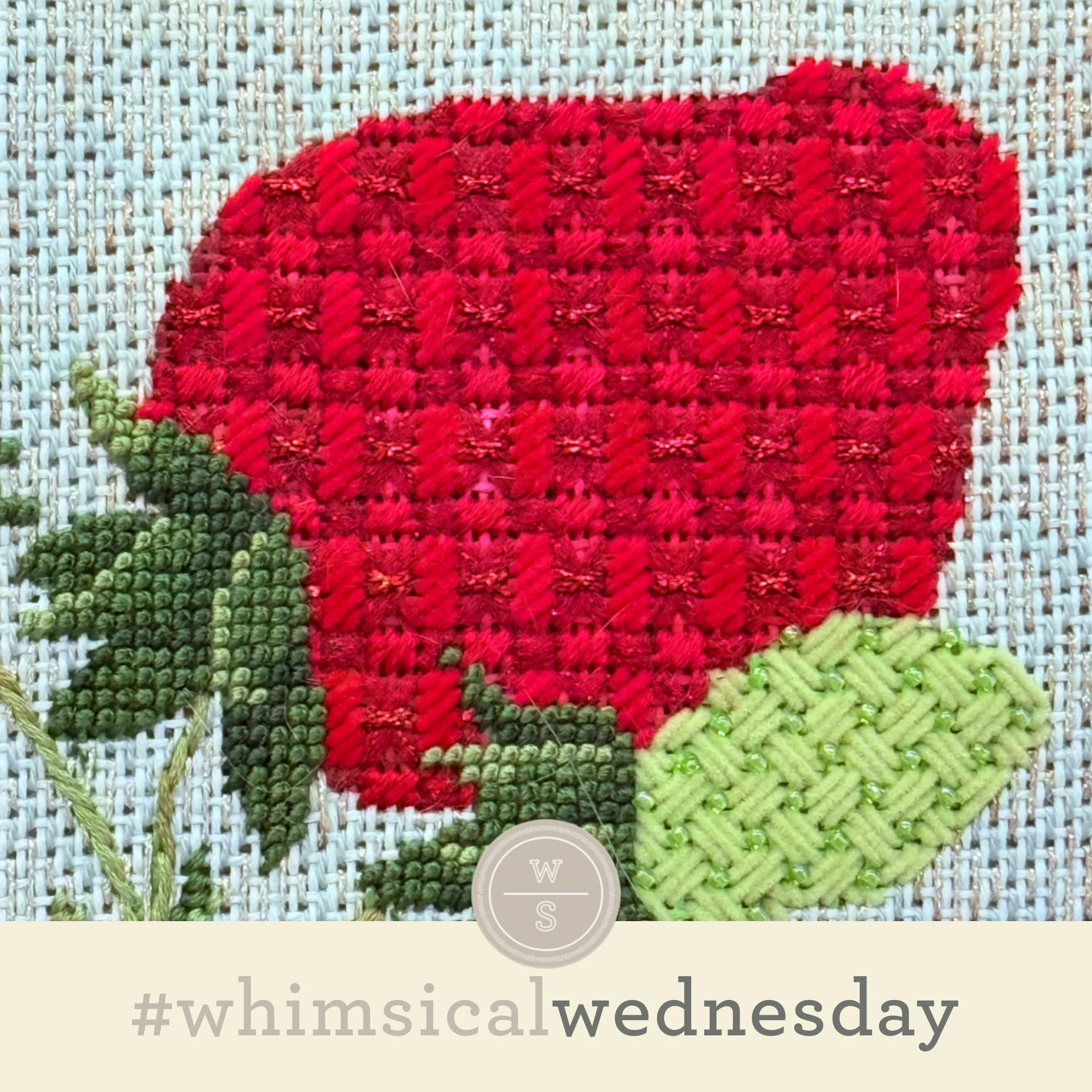
The fruit pillow is a vintage Melissa Shirley piece. Each strawberry is stitched in a different decorative stitch. Today’s is from the upper right-hand corner. It uses Petite Very Velvet (black lines), Flair (yellow and aqua lines), and a Kreinik metallic (gray lines) on 13M. No doubt about it…this stitch is a lot. But, there are times where that is appropriate. I emphasized the three strawberries and stitched the remaining areas in fairly straightforward stitches with lighter-weight threads.

This is a great stitch for good-sized fruit. Obvs. Looking at it with the bolder threads, this would work well with clothing you want to draw attention to. You could add subtlety to it with lighter-weight threads, such as silk perle for the black lines, and Silk Lame for the Smyrna Crosses. You could leave the remaining areas open or fill them with basketweave or reverse basketweave for a toned-down version. You could even replace the Smyrna Crosses with beads, which would be so much fun for wrapping paper!

Today’s stitch diagram, along with all other #whimsicalwednesday and #smallspacesunday stitch diagrams, can also be found on a Pinterest board here. Be sure to follow whimsicalstitch.com on FacebookPinterest, and Instagram.

I hope you have the perfect spot for this stitch! Please enjoy! Have a wonderful #whimsicalwednesday!

Click on image to see the whimsicalstitch.com Stitch Library on pinterest.com. Includes all #whimsicalwednesday and #smallspacesunday stitch diagrams.

As you are auditioning stitches (from any stitch source), count the number of canvas threads on the diagram that match your mesh size. And there you have what an inch of the stitch will look like. Evaluate that against the area where you plan to use the stitch and make your final decision. If you start integrating this step into your stitch selection process, you may be surprised at how many stitches you think are large are much smaller than you realize.

More from whimsicalstitch.com
If you like what you see on this blog, there's more. Mary’s Whimsical Stitches is a series of four books offering contemporary how-to collections of more than 200 stitches (in each volume) for all stitchers, regardless of skill level. All books include updated and sequenced diagrams from this blog, plus a collection of all-new stitches from private lessons and other class projects. Visit here to find a needlepoint retailer that carries my books.

New to needlepoint or looking for a refresher? Please download a handy how-to guide covering basic needlepoint stitches and stitch compensation techniques, along with new top-line information on needlepoint materials and tools, how to handle threads, and other helpful needlepoint resources.


A Note about Diagrams
I use color in diagrams to make them as clear as possible.  The primary function of different colored lines is to illustrate a stitch sequence.  For example, the layering of colors demonstrates you add them in that order.  They can also provide ideas on integrating additional threads (one line for each color).  Or, you can use the same thread for all color lines.  That's where I encourage you to use your imagination for the space you are stitching!
Why?

I rarely adhere to my Instagram time limits. That worked well for me as the early morning scrolling inspired today’s stitch.

Click the image to see the whimsicalstitch.com Stitch Library on pinterest.com. Includes all #whimsicalwednesday and #smallspacesunday stitch diagrams.

Click the image to see #whimsicalwednesday and #smallspacesunday Stitched Sample Gallery on Instagram

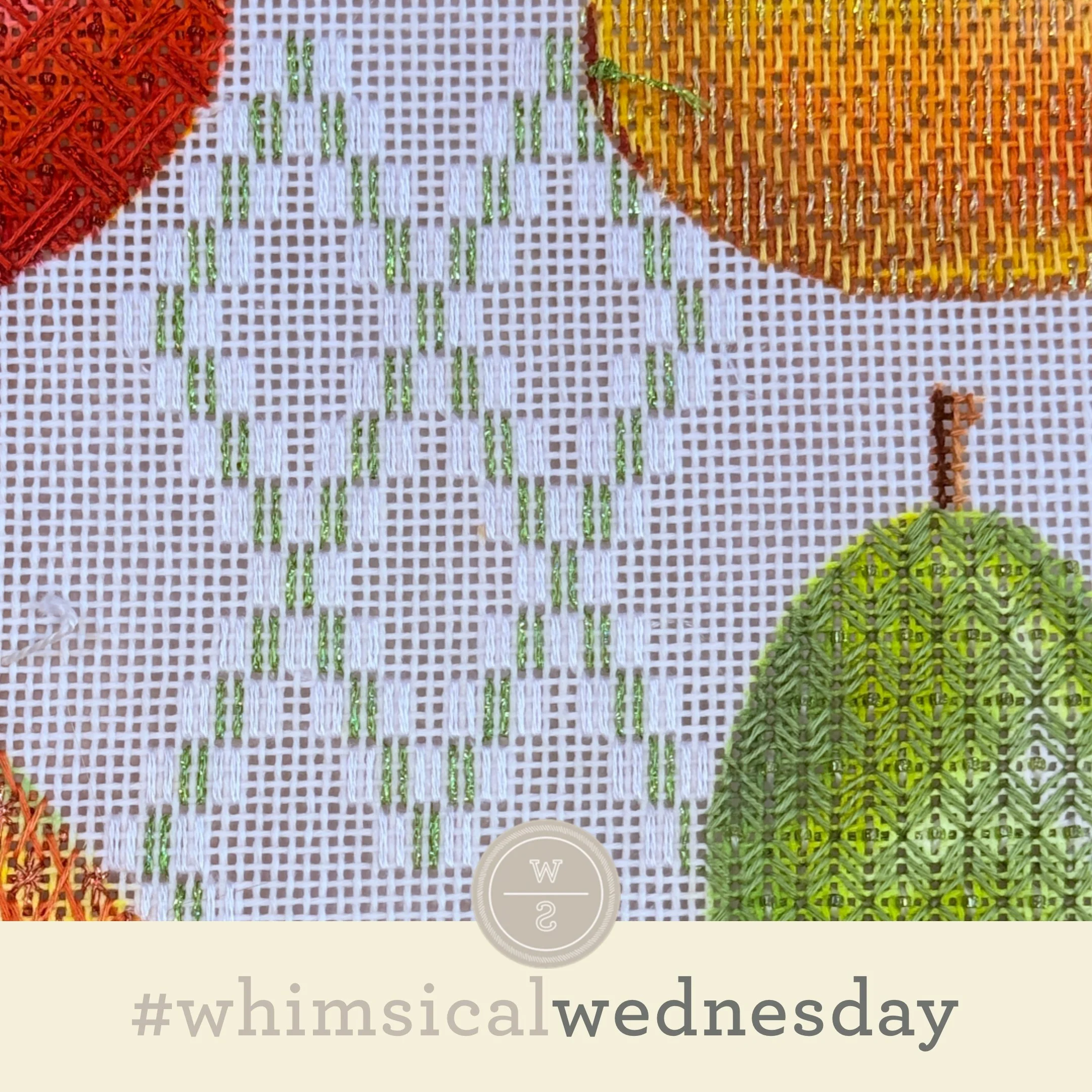
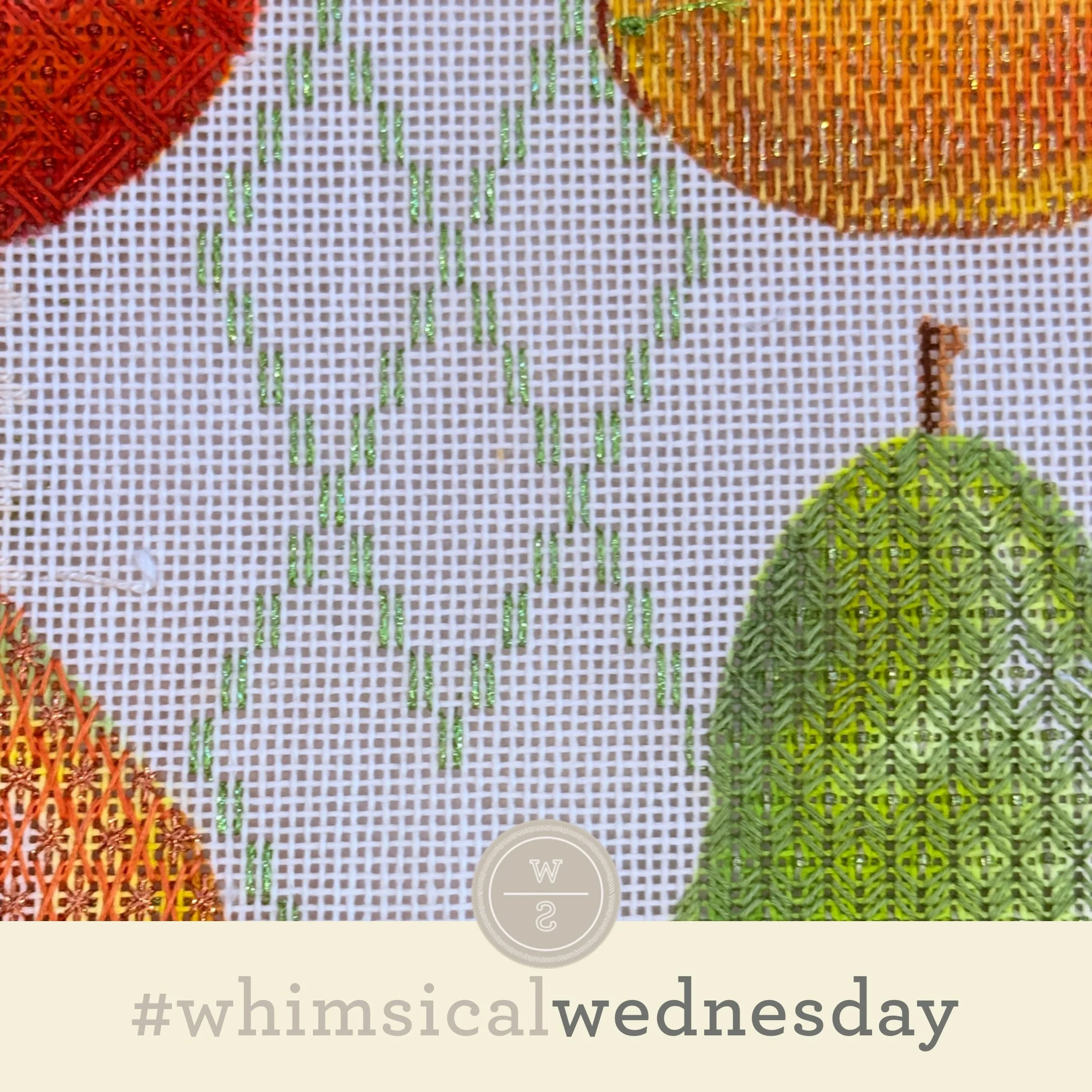
The stitched sample uses Silk Lame 18 (on 13M) for all lines on the diagram to create a background for a cute Christmas pillow. I look forward to using two different threads, as diagrammed, for this stitch on a pretty sundress, with Elegance for the back lines and Soie D'Alger for the turquoise lines. All of the stitches are three rows tall or wide. I want to play with scale a little bit and try a larger version to see how the open space plays out for a larger background space.

I hope you have the perfect spot for today’s stitch. Have fun playing with it!

Click on image to see the whimsicalstitch.com Stitch Library on pinterest.com. Includes all #whimsicalwednesday and #smallspacesunday stitch diagrams.

As you are auditioning stitches (from any stitch source), count the number of canvas threads on the diagram that match your mesh size. And there you have what an inch of the stitch will look like. Evaluate that against the area where you plan to use the stitch and make your final decision. If you start integrating this step into your stitch selection process, you may be surprised at how many stitches you think are large are much smaller than you realize.

By (sometimes) including this step in my own process, I find I am now integrating much longer stitches than I ever thought I would. I used to think a stitch six rows long was super big. I have very much changed my tune, which has helped me expand my creativity, especially for large-space stitches.

Today’s stitch diagram, along with all other #whimsicalwednesday and #smallspacesunday stitch diagrams, can also be found on a Pinterest board here. Be sure to follow whimsicalstitch.com on FacebookPinterestInstagram, and Twitter.

If you like what you see on this blog, there's more. Mary’s Whimsical Stitches is a series of four books offering contemporary how-to collections of more than 200 stitches (in each volume) for all stitchers, regardless of skill level. All books include updated and sequenced diagrams from this blog, plus a collection of all-new stitches from private lessons and other class projects. Visit here to find a needlepoint retailer that carries my books.

New to needlepoint or looking for a refresher? Please download a handy how-to guide covering basic needlepoint stitches and stitch compensation techniques along with new top-line information on needlepoint materials and tools, how to handle threads, and other helpful needlepoint resources.

whimsicalstitch.com also sells Stitch Guides and Stitch Concepts for Melissa Shirley Designs, Zecca DesignsSandra Gilmore, Purple Palm, Maggie, and Penny MacLeod, and many more. Click here to see the newest guides and click here to see the entire collection.

I hope you have the perfect spot for this stitch! Please enjoy! Have a wonderful #whimsicalwednesday!

A Note about Diagrams
I use color in diagrams to make them as clear as possible.  The primary function of different colored lines is to illustrate a stitch sequence.  For example, the layering of colors demonstrates you add them in that order.  They can also provide ideas on integrating additional threads (one line for each color).  Or, you can use the same thread for all color lines.  That's where I encourage you to use your imagination for the space you are stitching!
I Can Count on Her

It’s always fun to run into a stitching friend. Good to catch up on all kinds of news, especially what they are working on. All of the above just happened a couple days ago and she generously teed up an adorable variation of one of my favorite stitches!

Click the image to see the whimsicalstitch.com Stitch Library on pinterest.com. Includes all #whimsicalwednesday and #smallspacesunday stitch diagrams.

Click the image to see #whimsicalwednesday and #smallspacesunday Stitched Sample Gallery on Instagram

We chatted so much I forgot to ask what threads she used. My best guess is two, possibly three, shades of either Impressions (most likely one strand) strand most likely) or DMC size 8 on a 13M Charley Harper canvas.

I doubt I would have come up with this stitch independently as I am typically not a fan of straight stitches over one row. Virtually all of my beetle stitches have rows with an even number of stitches. But that straight stitch over one row is what makes this work. The stitched sample is a lawn/green space on the background of a sweet Charlie Harper animal canvas. I really want to play with it for a tree that has little to nothing on it, not even branches with similar threads as this background. I also look forward to a student using it as background for a simple initial ornament with three different white threads. I would use a white metallic for the black lines, a white metallic for the tent stitches splitting the beetles, and a white silk floss for the remaining yellow lines.

I hope you have the perfect spot for today’s stitch. Have fun playing with it!

Click on image to see the whimsicalstitch.com Stitch Library on pinterest.com. Includes all #whimsicalwednesday and #smallspacesunday stitch diagrams.

As you are auditioning stitches (from any stitch source), count the number of canvas threads on the diagram that match your mesh size. And there you have what an inch of the stitch will look like. Evaluate that against the area where you plan to use the stitch and make your final decision. If you start integrating this step into your stitch selection process, you may be surprised at how many stitches you think are large are much smaller than you realize.

By (sometimes) including this step in my own process, I find I am now integrating much longer stitches than I ever thought I would. I used to think a stitch six rows long was super big. I have very much changed my tune, which has helped me expand my creativity, especially for large-space stitches.

Today’s stitch diagram, along with all other #whimsicalwednesday and #smallspacesunday stitch diagrams, can also be found on a Pinterest board here. Be sure to follow whimsicalstitch.com on FacebookPinterestInstagram, and Twitter.

If you like what you see on this blog, there's more. Mary’s Whimsical Stitches is a series of four books offering contemporary how-to collections of more than 200 stitches (in each volume) for all stitchers, regardless of skill level. All books include updated and sequenced diagrams from this blog, plus a collection of all-new stitches from private lessons and other class projects. Visit here to find a needlepoint retailer that carries my books.

New to needlepoint or looking for a refresher? Please download a handy how-to guide covering basic needlepoint stitches and stitch compensation techniques along with new top-line information on needlepoint materials and tools, how to handle threads, and other helpful needlepoint resources.

whimsicalstitch.com also sells Stitch Guides and Stitch Concepts for Melissa Shirley Designs, Zecca DesignsSandra Gilmore, Purple Palm, Maggie, and Penny MacLeod, and many more. Click here to see the newest guides and click here to see the entire collection.

I hope you have the perfect spot for this stitch! Please enjoy! Have a wonderful #whimsicalwednesday!

A Note about Diagrams
I use color in diagrams to make them as clear as possible.  The primary function of different colored lines is to illustrate a stitch sequence.  For example, the layering of colors demonstrates you add them in that order.  They can also provide ideas on integrating additional threads (one line for each color).  Or, you can use the same thread for all color lines.  That's where I encourage you to use your imagination for the space you are stitching!
Hello Again!

And we are back! Today’s stitch is a fun combo of diagonal and oblique stitches that brings out the beautiful painting underneath.

Click the image to see the whimsicalstitch.com Stitch Library on pinterest.com. Includes all #whimsicalwednesday and #smallspacesunday stitch diagrams.

Click the image to see #whimsicalwednesday and #smallspacesunday Stitched Sample Gallery on Instagram

The stitched sample is a pair of oranges from a new Melissa Shirley piece. I used two plies of Soie D'Alger (black lines) and size 4 ThreadWorx Metallic for the aqua lines on 18M. Melissa Shirley canvases are why I love open stitches. Basketweave and continental belong on every canvas, in my opinion, but finding threads that replicate all the delicate hues in shading is virtually impossible. Well-painted shading has an almost watercolor-like effect…and open stitches help bring that out spectacularly.

Today’s stitch is filed under “general all-purpose wonderfulness.” It will make lovely clothing, especially a summer dress for a young girl with Elegance (black lines) and Trebizond Silk for the aqua lines. It will also create fun greenery for trees with overdyed silk floss (black lines) and Silk Lame (aqua lines). To help keep the open spaces clear of dragged threads, I recommend adding the two stitches following diagonal paths.

I hope you have the perfect spot for today’s stitch. Have fun playing with it!

Click on image to see the whimsicalstitch.com Stitch Library on pinterest.com. Includes all #whimsicalwednesday and #smallspacesunday stitch diagrams.

As you are auditioning stitches (from any stitch source), count the number of canvas threads on the diagram that match your mesh size. And there you have what an inch of the stitch will look like. Evaluate that against the area where you plan to use the stitch and make your final decision. If you start integrating this step into your stitch selection process, you may be surprised at how many stitches you think are large are much smaller than you realize.

By (sometimes) including this step in my own process, I find I am now integrating much longer stitches than I ever thought I would. I used to think a stitch six rows long was super big. I have very much changed my tune, which has helped me expand my creativity, especially for large-space stitches.

Today’s stitch diagram, along with all other #whimsicalwednesday and #smallspacesunday stitch diagrams, can also be found on a Pinterest board here. Be sure to follow whimsicalstitch.com on FacebookPinterestInstagram, and Twitter.

If you like what you see on this blog, there's more. Mary’s Whimsical Stitches is a series of four books offering contemporary how-to collections of more than 200 stitches (in each volume) for all stitchers, regardless of skill level. All books include updated and sequenced diagrams from this blog, plus a collection of all-new stitches from private lessons and other class projects. Visit here to find a needlepoint retailer that carries my books.

New to needlepoint or looking for a refresher? Please download a handy how-to guide covering basic needlepoint stitches and stitch compensation techniques along with new top-line information on needlepoint materials and tools, how to handle threads, and other helpful needlepoint resources.

whimsicalstitch.com also sells Stitch Guides and Stitch Concepts for Melissa Shirley Designs, Zecca DesignsSandra Gilmore, Purple Palm, Maggie, and Penny MacLeod, and many more. Click here to see the newest guides and click here to see the entire collection.

I hope you have the perfect spot for this stitch! Please enjoy! Have a wonderful #whimsicalwednesday!

A Note about Diagrams
I use color in diagrams to make them as clear as possible.  The primary function of different colored lines is to illustrate a stitch sequence.  For example, the layering of colors demonstrates you add them in that order.  They can also provide ideas on integrating additional threads (one line for each color).  Or, you can use the same thread for all color lines.  That's where I encourage you to use your imagination for the space you are stitching!