

Today’s stitch was inspired by a fun stitch from Bedecked and Beadazzled I shared a few years ago. It’s also a work in progress, but a great opportunity to see how I work to minimize visible threads.
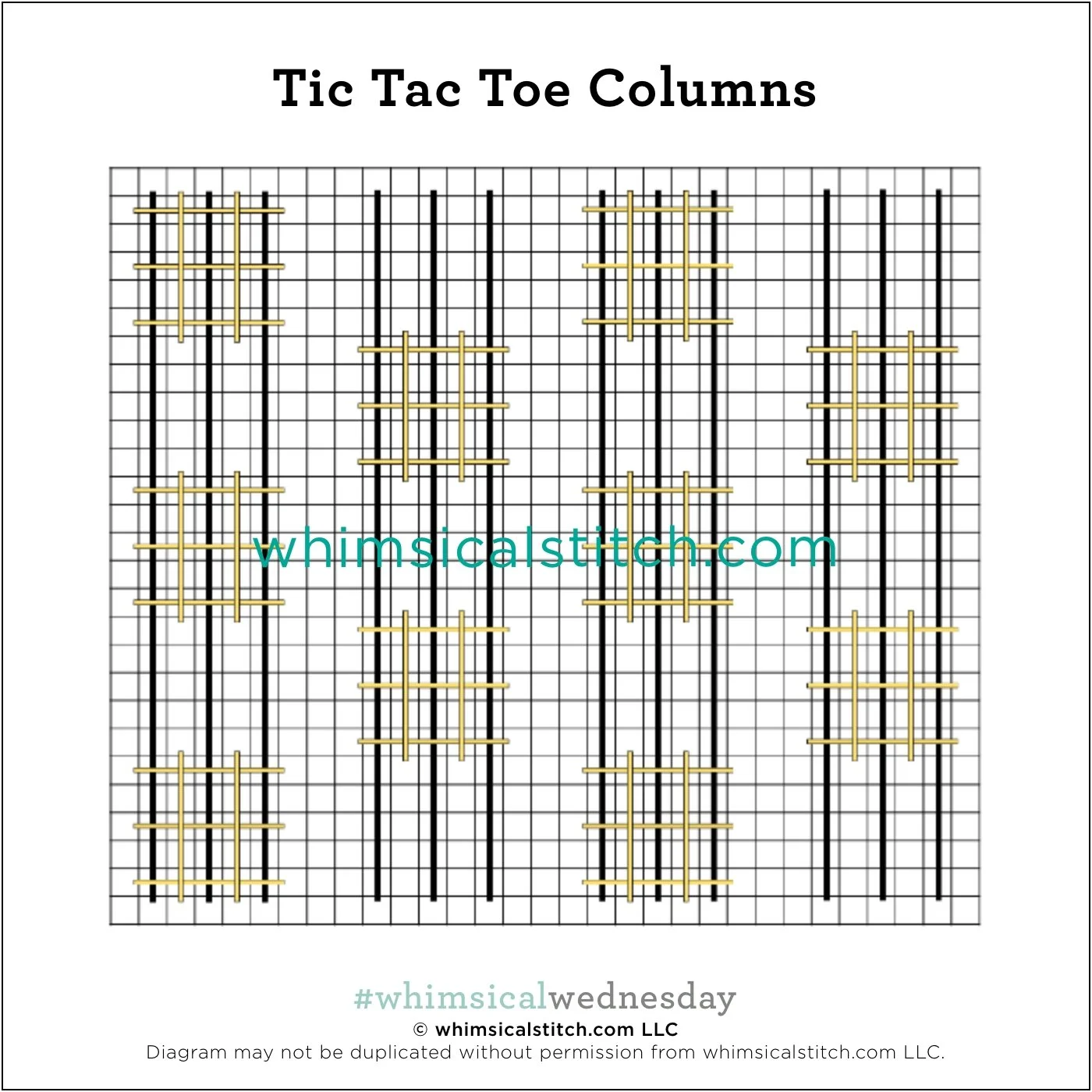
Click on image to see on pinterest. Visit pinterest.com/whimsicalstitch/whimsicalwednesday for a library of all #whimsicalwednesday and #smallspacesunday stitch diagrams.

Click the image to see #whimsicalwednesday and #smallspacesunday Stitched Sample Gallery on Instagram
First, the stitch. I used blue Pepper Pot Silk (black lines) and size 12 Kreinik braid (yellow lines). The original plan was to stitch just the horizontal yellow lines, similar to the inspiration stitch. But something was missing, so I added the vertical lines on top of the horizontal lines and was happy with where I landed. Well, honestly, I may change the Kreinik to a lighter-weight metallic to make it recede a little bit.
I like this as a background stitch and you can add more or less space between the columns to achieve the coverage you want. I’m looking forward to using this on a basket with an overdyed wool for the black lines with a solid color silk floss for the yellow lines and NO skipped rows between the columns.
There are two examples of how I navigate open stitches on the stitched sample. The first, a small running stitch, is in the lower right-hand corner. When I completed the column on the far right, I needed to return to start the column under the S. The running stitch 1-2 rows away from the design area will be swallowed by the fabrication of the ornament. Magic! There is a waste knot (aka away knot) underneath the long vertical stitches on the upper right of the canvas. I added that knot in the direct path of the long vertical stitch and it will stay there until I add the Kreinik on top of those three stitches.
Today’s stitch diagram, along with all other #whimsicalwednesday and #smallspacesunday stitch diagrams, can also be found on a Pinterest board here. Be sure to follow whimsicalstitch.com on Facebook, Pinterest, and Instagram.
Click on image to see the whimsicalstitch.com Stitch Library on pinterest.com. Includes all #whimsicalwednesday and #smallspacesunday stitch diagrams.
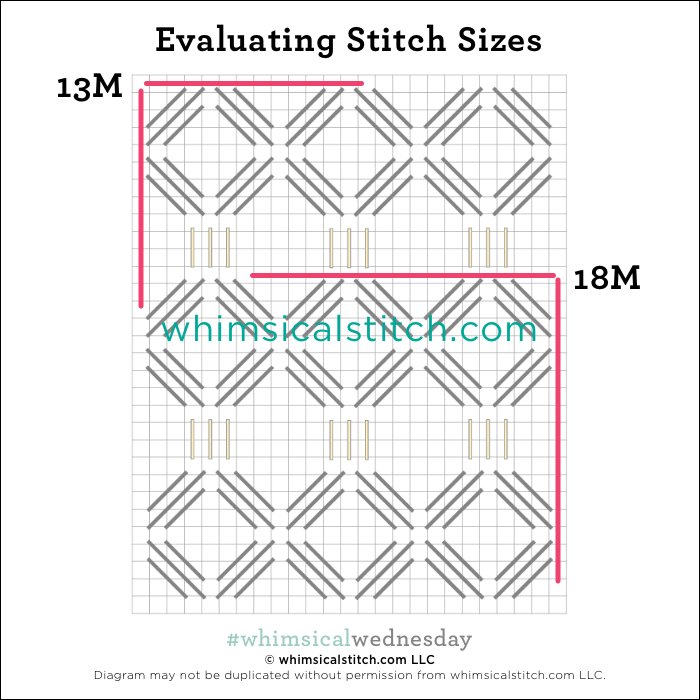
As you are auditioning stitches (from any stitch source), count the number of canvas threads on the diagram that match your mesh size. And there you have what an inch of the stitch will look like. Evaluate that against the area where you plan to use the stitch and make your final decision. If you start integrating this step into your stitch selection process, you may be surprised at how many stitches you think are large are much smaller than you realize.
More from whimsicalstitch.com
If you like what you see on this blog, there's more. Mary’s Whimsical Stitches is a series of four books offering contemporary how-to collections of more than 200 stitches (in each volume) for all stitchers, regardless of skill level. All books include updated and sequenced diagrams from this blog, plus a collection of all-new stitches from private lessons and other class projects. Visit here to find a needlepoint retailer that carries my books.
New to needlepoint or looking for a refresher? Please download a handy how-to guide covering basic needlepoint stitches and stitch compensation techniques, along with new top-line information on needlepoint materials and tools, how to handle threads, and other helpful needlepoint resources.
A Note about Diagrams
I use color in diagrams to make them as clear as possible. The primary function of different colored lines is to illustrate a stitch sequence. For example, the layering of colors demonstrates you add them in that order. They can also provide ideas on integrating additional threads (one line for each color). Or, you can use the same thread for all color lines. That's where I encourage you to use your imagination for the space you are stitching!