

Today’s stitch is from one of my favorite stitch guides. If you are a fan of my office manager, you will understand why.
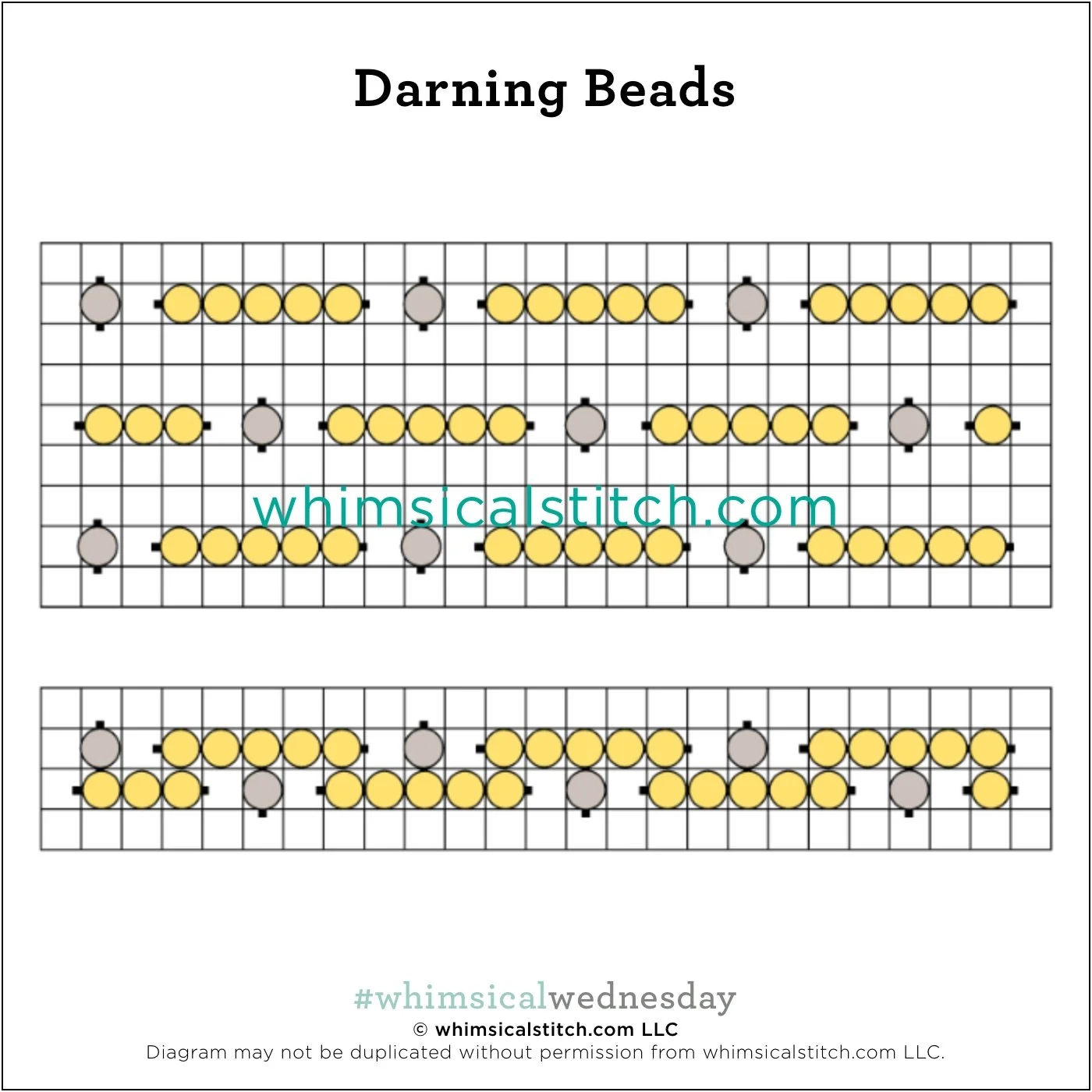
Click the image to see the whimsicalstitch.com Stitch Library on pinterest.com. Includes all #whimsicalwednesday and #smallspacesunday stitch diagrams.
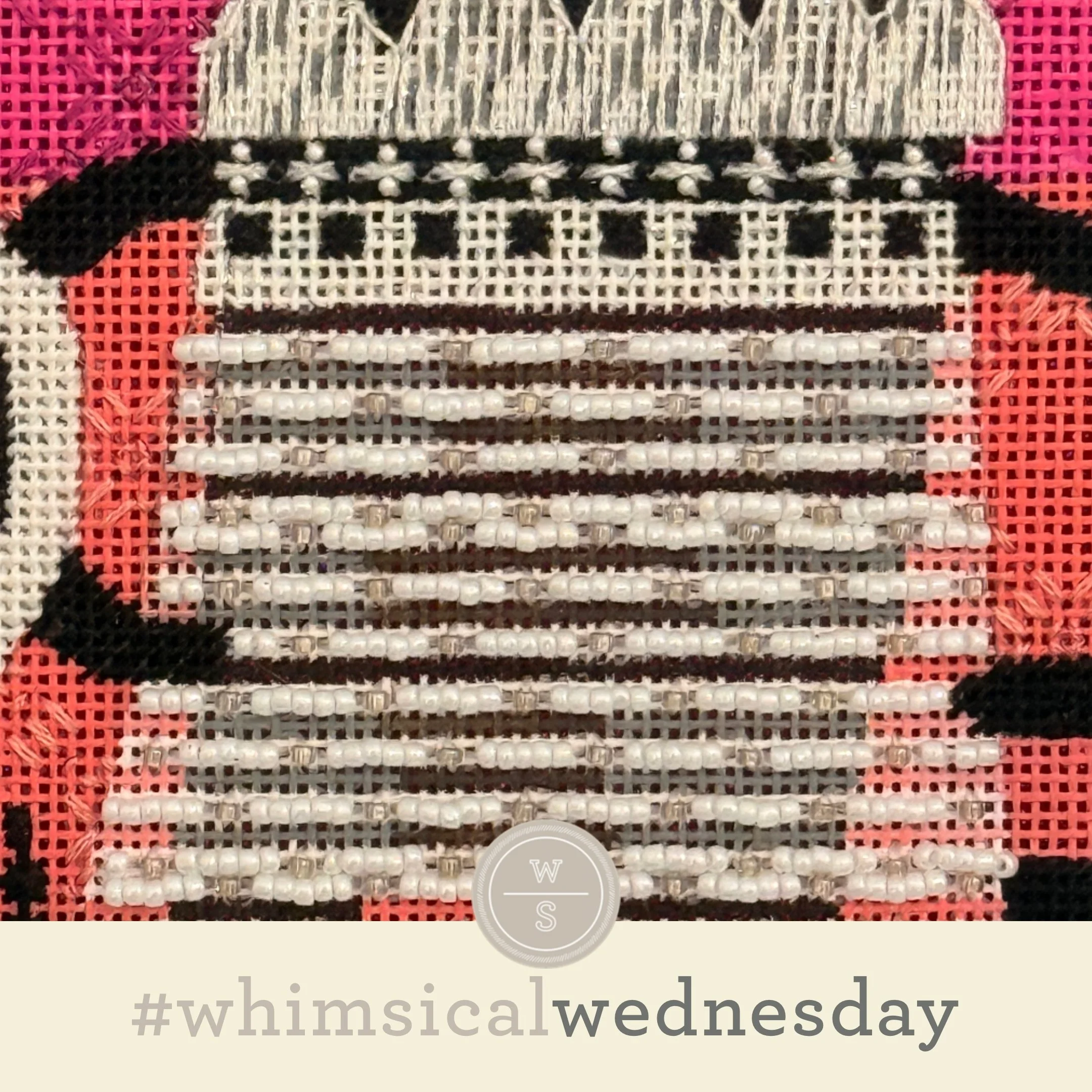
Click the image to see #whimsicalwednesday and #smallspacesunday Stitched Sample Gallery on Instagram
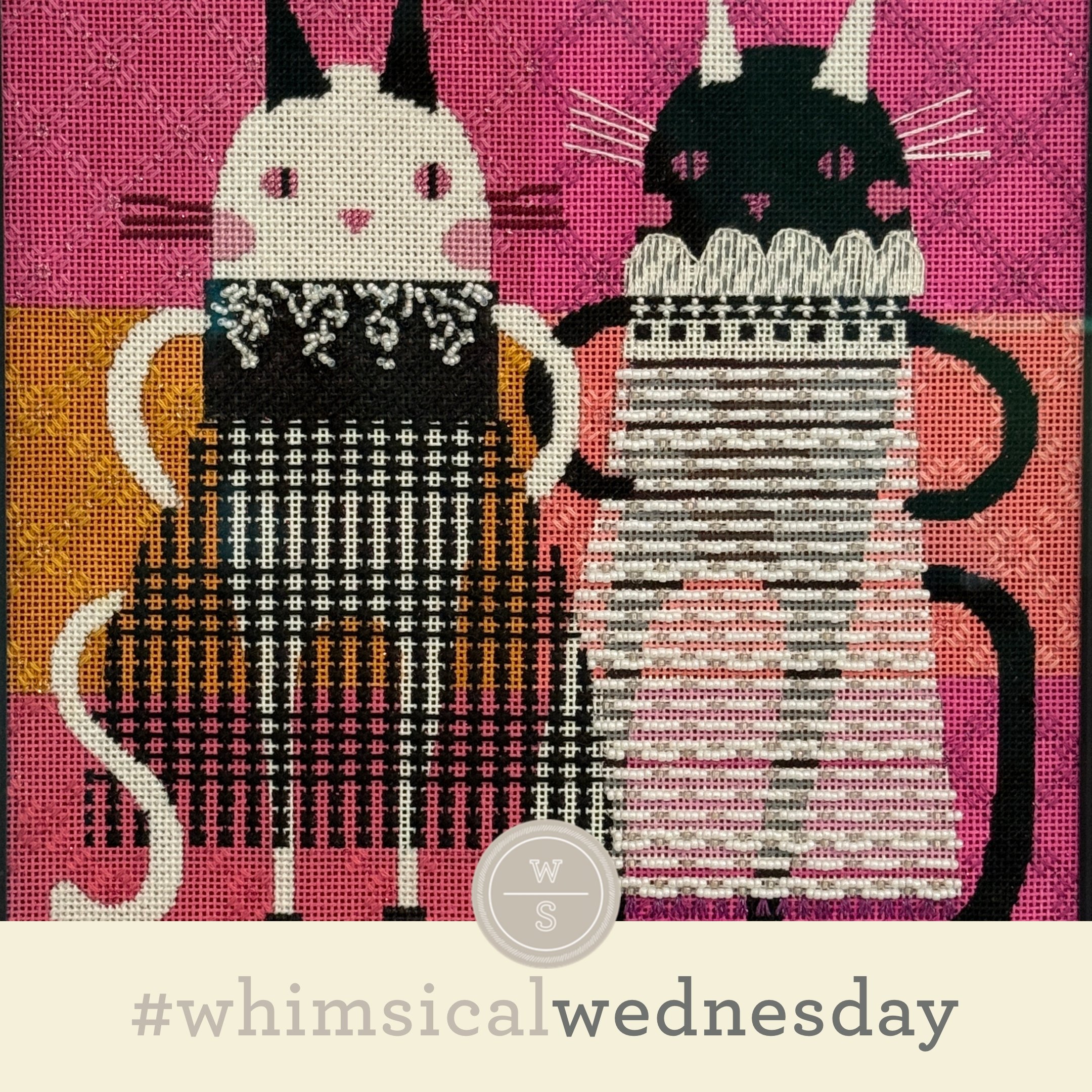
Click the image to see #whimsicalwednesday and #smallspacesunday Stitched Sample Gallery on Instagram
Yes, the cats are wearing see-through dresses, and it never occurred to me to change that. Today’s featured dress is the one on the right, which is simply adorned with silver and white beads. I used a darning stitch for the white beads. I added a silver bead between the groups of white beads. You have no idea how happy I was to stitch this piece, and it makes me smile every time I see it on my office wall.
As a whole, darning stitches are similar to running stitches, simply traveling along a directional path, creating a smooth stitch versus the crisp wrapped edge of a traditional needlepoint stitch. The direction can be straight or diagonal. You do need to ensure you have enough thread to complete a row from edge to edge, as ending a darning stitch mid-row creates an uneven look. Admittedly, a darning stitch with beads will never be what one would call smooth, but I’m hoping this inspires you to consider more darning stitches as a whole.
Darning beads certainly are not a universal stitch but it’s one of those stitches that you will know is the one when you know. I could see it used for Christmas wrapping paper (with red and gold beads), snow on a roof (with white and very light blue beads), or even a frozen lake (with clear beads).
Have fun with it!
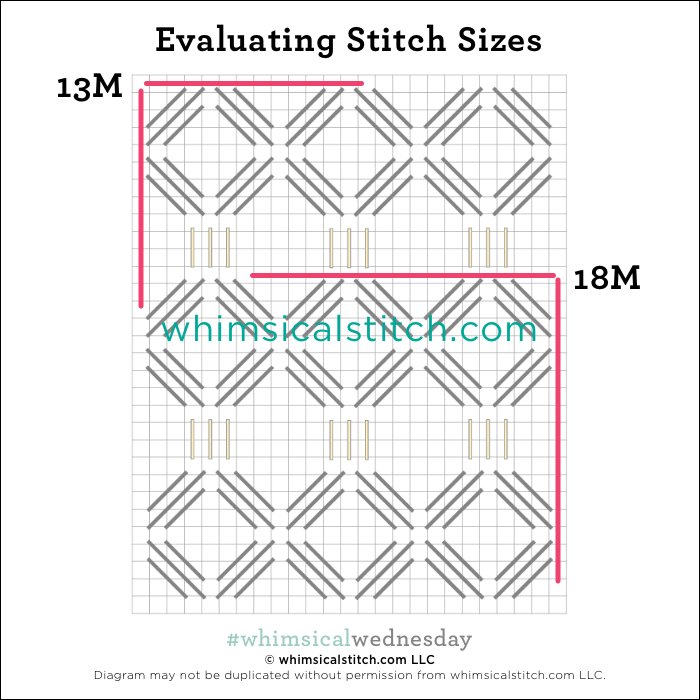
Click on image to see the whimsicalstitch.com Stitch Library on pinterest.com. Includes all #whimsicalwednesday and #smallspacesunday stitch diagrams.
As you are auditioning stitches (from any stitch source), count the number of canvas threads on the diagram that match your mesh size. And there you have what an inch of the stitch will look like. Evaluate that against the area where you plan to use the stitch and make your final decision. If you start integrating this step into your stitch selection process, you may be surprised at how many stitches you think are large are much smaller than you realize.
By (sometimes) including this step in my own process, I find I am now integrating much longer stitches than I ever thought I would. I used to think a stitch six rows long was super big. I have very much changed my tune, which has helped me expand my creativity, especially for large-space stitches.
Today’s stitch diagram, along with all other #whimsicalwednesday and #smallspacesunday stitch diagrams, can also be found on a Pinterest board here. Be sure to follow whimsicalstitch.com on Facebook, Pinterest, Instagram, and Twitter.
If you like what you see on this blog, there's more. Mary’s Whimsical Stitches is a series of four books offering contemporary how-to collections of more than 200 stitches (in each volume) for all stitchers, regardless of skill level. All books include updated and sequenced diagrams from this blog, plus a collection of all-new stitches from private lessons and other class projects. Visit here to find a needlepoint retailer that carries my books.
New to needlepoint or looking for a refresher? Please download a handy how-to guide covering basic needlepoint stitches and stitch compensation techniques along with new top-line information on needlepoint materials and tools, how to handle threads, and other helpful needlepoint resources.
whimsicalstitch.com also sells Stitch Guides and Stitch Concepts for Melissa Shirley Designs, Zecca Designs, Sandra Gilmore, Purple Palm, Maggie, and Penny MacLeod, and many more. Click here to see the newest guides and click here to see the entire collection.
I hope you have the perfect spot for this stitch! Please enjoy! Have a wonderful #whimsicalwednesday!
A Note about Diagrams
I use color in diagrams to make them as clear as possible. The primary function of different colored lines is to illustrate a stitch sequence. For example, the layering of colors demonstrates you add them in that order. They can also provide ideas on integrating additional threads (one line for each color). Or, you can use the same thread for all color lines. That's where I encourage you to use your imagination for the space you are stitching!
