
It’s been a little nutty here for the past month or so. The good news is I have a clean closet, volume 5 is at the printer, and I found a stitch for today!
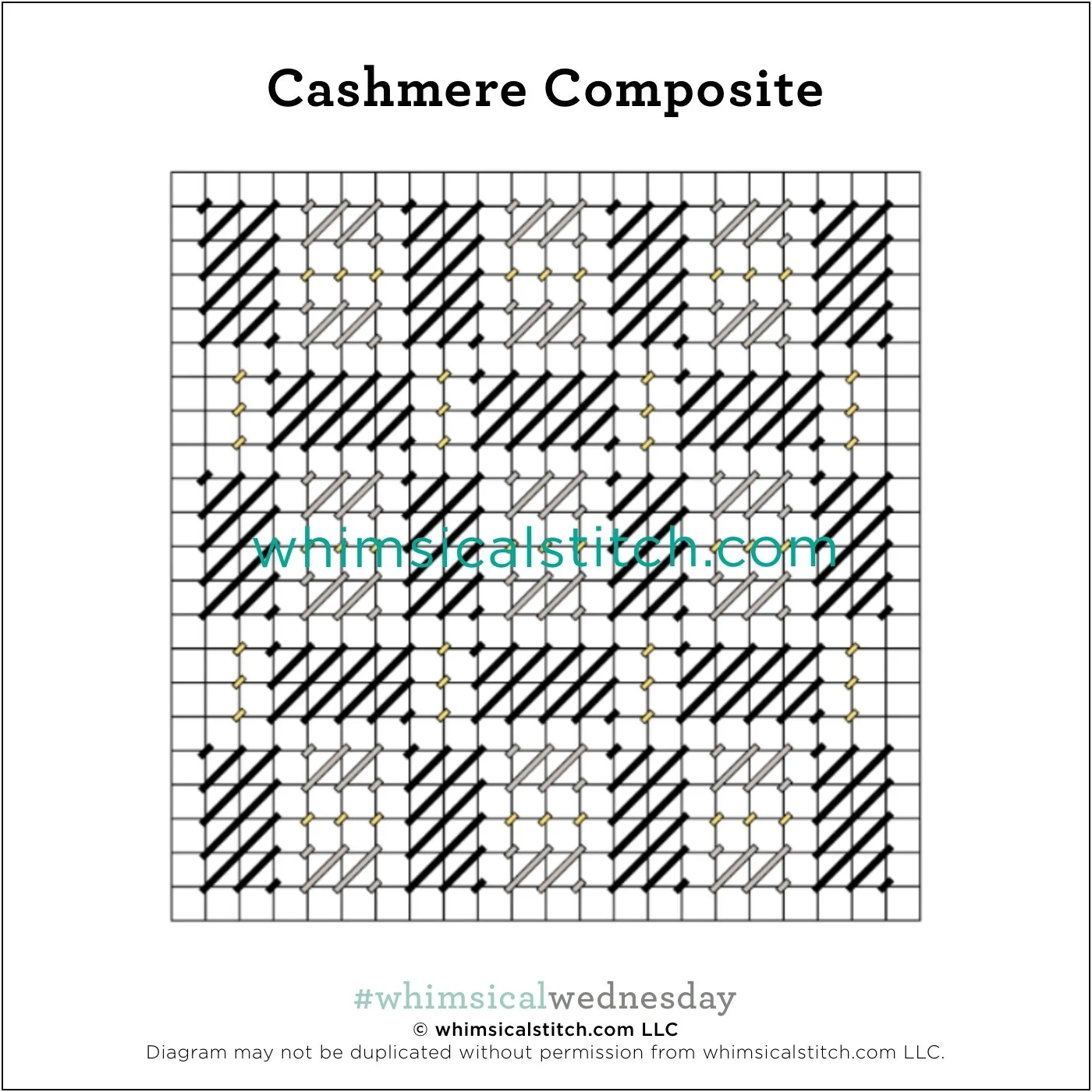
Click on image to see on pinterest. Visit pinterest.com/whimsicalstitch/whimsicalwednesday for a library of all #whimsicalwednesday and #smallspacesunday stitch diagrams.
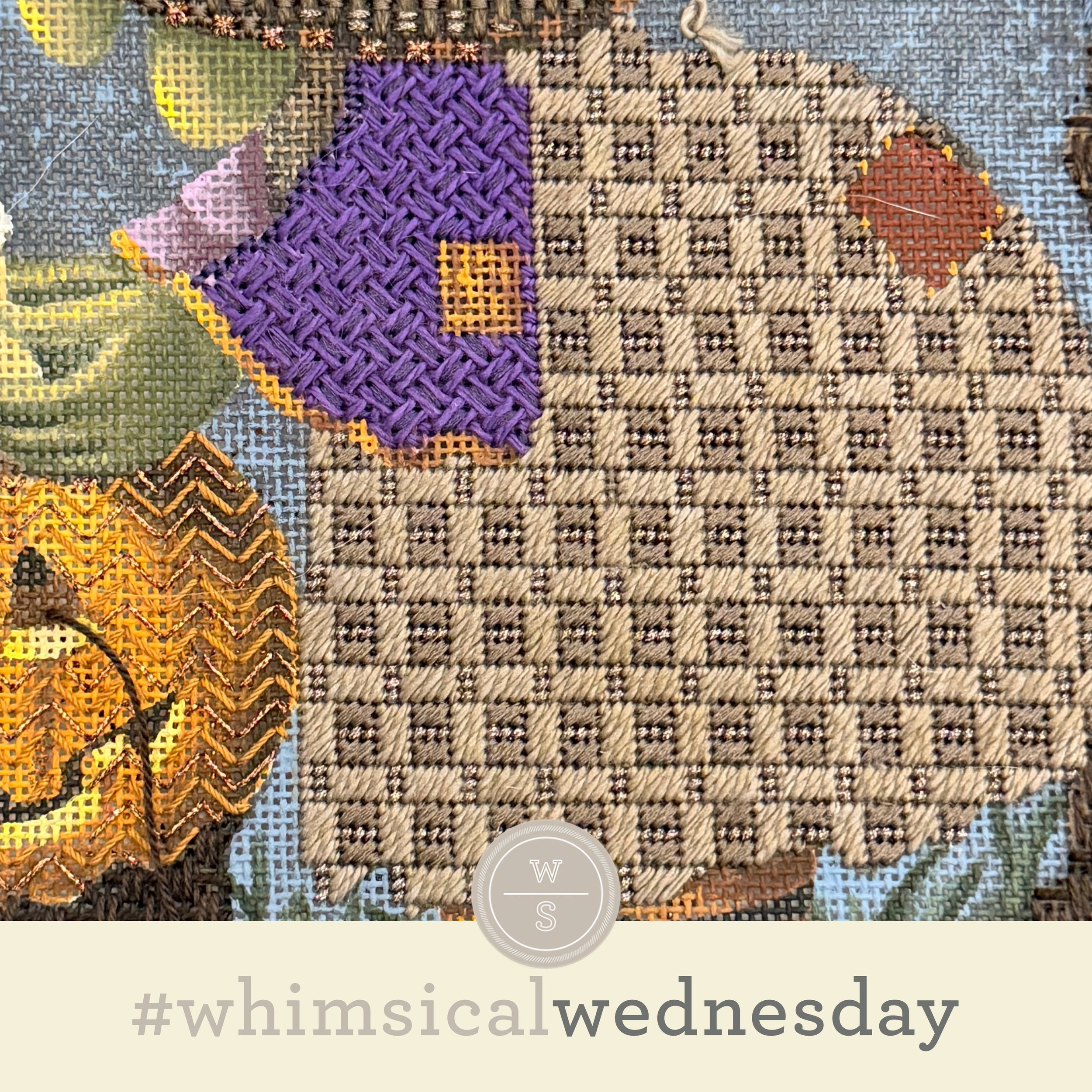
Click the image to see #whimsicalwednesday and #smallspacesunday Stitched Sample Gallery on Instagram
Let’s start from the last point, which is related to the first point. Today’s stitch was found (yesterday) in my WIP stash, buried in my closet. This is a forever-old Liz Goodrich Dillon witch, and I may have squealed when I found it. It is also possible I forgot about this project, and as soon as I saw it, I remembered how much I loved it and can’t wait to finish it soon. My best guess is I used Vineyard Silk (black lines), Neon Rays (gray lines), and size 12 Kreinik (from a spool) for the yellow lines.
This is a great all-purpose stitch for clothing (obvs) or many architectural elements, such as floors, roofs, or walls. Wrapping paper also comes to mind. Again, a great all-purpose stitch. I don’t think you will be surprised to hear that I love the black lines and the vertical groups of yellow lines on their own just as much. I look forward to using that version for a background, and eliminating the smaller rectangles and horizontal groups of yellow lines.
And last, but not least, this stitch is scalable, and you can accomplish some wonderful things with larger rectangles. That is what I’m going to play with very, very soon.
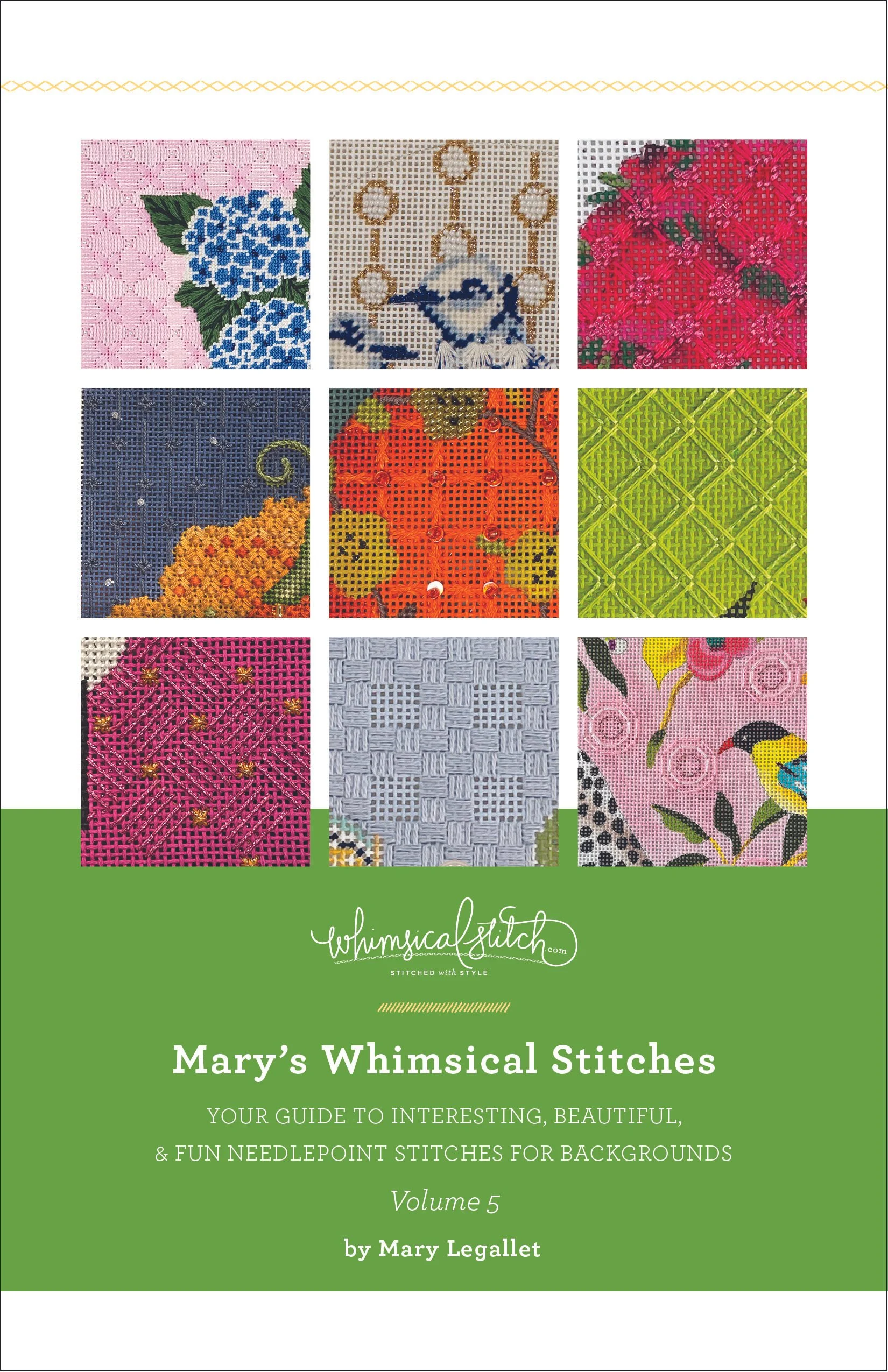
A preview of volume 5. Stay tuned for more info!
And, yes, my book is almost on its way to stores! Mary’s Whimsical Stitches Volume 5 is dedicated to background stitches of all sizes and shapes.
Packed with over 150 stitches, Volume 5 offers you the widest variety of backgrounds. There are large backgrounds, small backgrounds, and everything in between. And more than 75% of the stitches will have a QR code taking your customers to a stitched sample. The target ship date is now early July.
Hope you have fun with the stitch and are as excited about Volume 5 as I am!
A Note about Diagrams
I use color in diagrams to make them as clear as possible. The primary function of different colored lines is to illustrate a stitch sequence. For example, the layering of colors demonstrates that you add them in that order. They can also provide ideas for integrating additional threads (one line per color). Or, you can use the same thread for all color lines. That's where I encourage you to use your imagination for the space you are stitching.
Click on image to see the whimsicalstitch.com Stitch Library on pinterest.com. Includes all #whimsicalwednesday and #smallspacesunday stitch diagrams.
Evaluating Stitches for Your Project
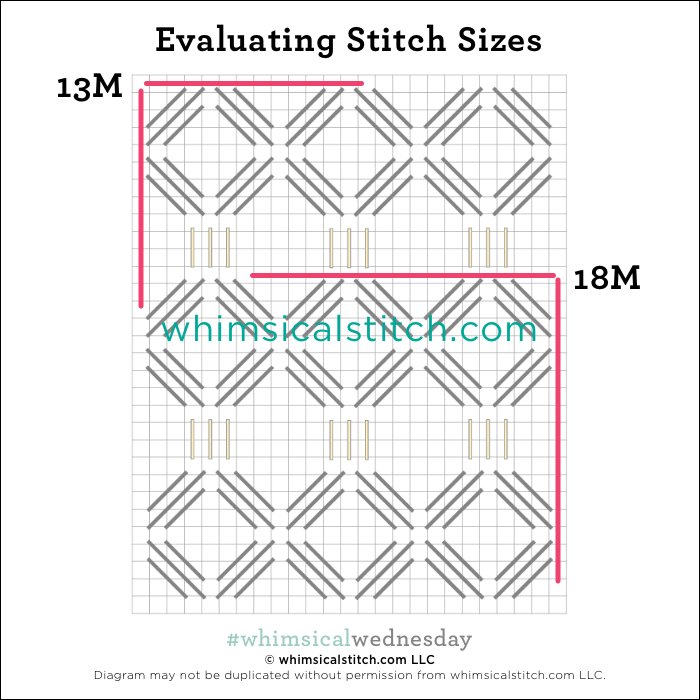
As you are auditioning stitches (from any stitch source), count the number of canvas threads on the diagram that match your mesh size. And there you have what an inch of the stitch will look like. Evaluate it against the area where you plan to use the stitch, then make your final decision. If you start integrating this step into your stitch selection process, you may be surprised at how many stitches you think are large are much smaller than you realize.
A Note about Stitch Names
I am absolutely loving the rising popularity of needlepoint, and if you are new to the blog, I want to take a second to chat about stitch names (again). TLDR: Don’t overthink them.
Most of the names for the stitches you see here are made up out of whole cloth. When I started needlepointing 30+ years ago, a teacher would draw or describe what she recommended, and off I went. Seriously. When I started my blog, an industry friend told me stitch names were crucial. I searched high and low for proper stitch names. What I found was stitches with no names or, even worse, identical stitches with two+ names from different sources. On top of that, some of my favorite stitches had generic names, such as Rug 1 and Rug 2. I quickly learned to focus on the diagrams, which are prettier. A stitch by any other name is still just as interesting!
There are some commonly understood stitch names, such as basketweave, continental, Scotch (3X3 and above squares), Mosaic (2X2 squares), Smyrna Crosses, and Hungarian (groups of diagonal stitches over 2-3-2 rows). It feels like it ends there. When naming stitches for my blog and books, I make every attempt to integrate generally accepted names, but also feel that a legible diagram is more important.
I’ve also learned that there is a very good chance that a stitch pattern that I come up with may not be new. But it is new to me. I spent almost an entire afternoon at a stitching friend’s home, poring through binders of stitches she gathered over decades. Not only were many of them drawn by hand (whoa!), I discovered stitches I thought were created decades later, with a different name, in a different presentation, from a different source. So, a stitch doesn’t belong to a single person or teacher. They are all part of a huge and decades-old network of really creative people.
Today’s stitch diagram, along with all other #whimsicalwednesday and #smallspacesunday stitch diagrams, can also be found on a Pinterest board here. Be sure to follow whimsicalstitch.com on Facebook, Pinterest, and Instagram.
More from whimsicalstitch.com
If you like what you see on this blog, there's more. Mary’s Whimsical Stitches is a series of four books offering contemporary how-to collections of more than 200 stitches (in each volume) for all stitchers, regardless of skill level. All books include updated and sequenced diagrams from this blog, plus a collection of all-new stitches from private lessons and other class projects. Visit here to find a needlepoint retailer that carries my books.
New to needlepoint or looking for a refresher? Please download a handy how-to guide covering basic needlepoint stitches and stitch compensation techniques, along with new top-line information on needlepoint materials and tools, how to handle threads, and other helpful needlepoint resources.